

Via Irhal
Joey Scozzari
Contributor
I visited the Gare Centrale de Montréal recently because I wanted to visit a train station. I hold the opinion that one should not need a reason to wander into large buildings. I figured this arrangement would lend itself to productive work, maybe culminating in a story about infrastructure. Commuters form lines near baggage claim, mallesque Christmas decorations hide the modernist ornaments that define the building. It feels like two time periods clashing. The writing is literally on the walls; O’ Canada and other national incantations serve as subtitles for the abstractions that make up the bas-reliefs ornamenting the surfaces—lumber workers, chiseled renditions of different landmarks, et cetera. What lines the station’s extremities are small stores selling foodstuffs, gadgets, travel appliances, and a large food court to house commuters in limbo. It was within this hall, named Les Halles de la Gare, that the idea for this article matured.
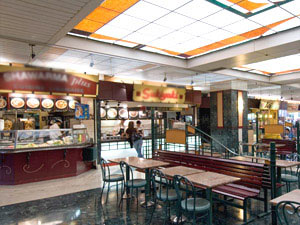
I became obsessed with the decor. Earth tones, Roman-style pillars, iron swirl tables, dark wood finishing, frescoes of the Mediterranean, painterly renditions of Art Deco caricatures sitting and enjoying each other’s company, cups of coffee with wisps of steam emanating from their surfaces, cornucopias overflowing with fresh produce, facades emulating the comfort and introspection found in a study lined with mahogany, checkered floors, and the mosaics and lanterns lining the walkways. Contemporary art historians christened this the Global Village Coffeehouse: carefully manufactured sentimentality, twee and familiarity. It is not nostalgic so much as it is comfortable. GVC is functionally tasteful greenwashing, unity, fair trade, locally sourced, organic, a slice of the Mediterranean in your own home with notes of You Got Mail, Times New Roman, Nat Sherman’s luxury brand of A Touch Of Clove filtered cigarettes, and an unbridled turn-of-the-millennium optimism. Chris Standring’s Kaleidoscope, Pat Metheny’s And Then I Knew, Oh! Penelope’s Lait Au Miel, Sixpence None The Richer’s Kiss Me. Businesses line the walkways, filling space with bakeries, ready-made Italian and Greek made mall buffet style, coffee shops, breweries, and vast swaths of dining areas. Everything was brown. Brown, brown, brown. Even if it was all hogwash, it all felt right. Facades are meant to conceal a less pleasant reality, networks of wire lie behind the drywall. The food itself is of poor quality, too. Carbs kept gasping for air under a heat lamp until the world keeled over. There is always an air of deception, and it smells.
I was incredibly disappointed when Alexis Nihon opened its newly renovated food court to the public. Prior to renovations, it had embodied the Global Village. Iron twirl chairs, dark earthy tones, wood finishing, geometric storefronts (the byproduct of the limitations present in primitive computer-automated design software), warm overhead lamps, and the mall’s name signed in reflective gold coloring on every food tray. It sold you the notion of confidence in the establishment. A food court is not luxurious, and any attempt to separate the connotations of such a thing from the layman is foolish and heartless. A few food courts do this; Time Out Market and Le Central come to mind. If you had money, you would just go to a restaurant. Furthermore, the food court was incredibly spacious. This decision might have been to the detriment of the developers, as loiterers would find great solace in spending whole days staring out of the large glass panes at Maisonneuve Street. What there is now is what I can only describe as a third-year interior design student’s summative assessment. White glossy tile on everything, fake birch wood panelling (fake wood is a stylistic decision I could get behind if it were at all friendly to the eye), hospital lighting, fake vines hung overhead, tall, uncomfortable stools, bloated pillars that reduce the seating capacity by a considerable amount, and replacing every restaurant with some variation of protein bowl and/or wrap-slop.
In this time, every publicly accessible building follows this ethos. Terrified of stagnation, they follow the millennial school of consumer design to a tee. Make every building look like a MacBook. Give it a name一 BONAP sounds like some government bureau. Use a common idiom or adjective, purposely omitting letters so the reader does the heavy lifting. The mall is a mobile app that disrupts industry and builds powerful social connections, right? There’s no point in making snide remarks about a building that has already been built. This hurts. I would like to find beauty in this construction一a greater question would be whether or not embracing GVC would help at all, given trends in consumer preferences一but I doubt the developers took it upon themselves to think about beauty at all through the renovation. Maybe I am foolish for deluding myself into wanting nice things. Maybe I should just go get a thirteen-dollar bowl of whatever and rice; maybe then I will be happy with an eyesore.


Leave a Reply