

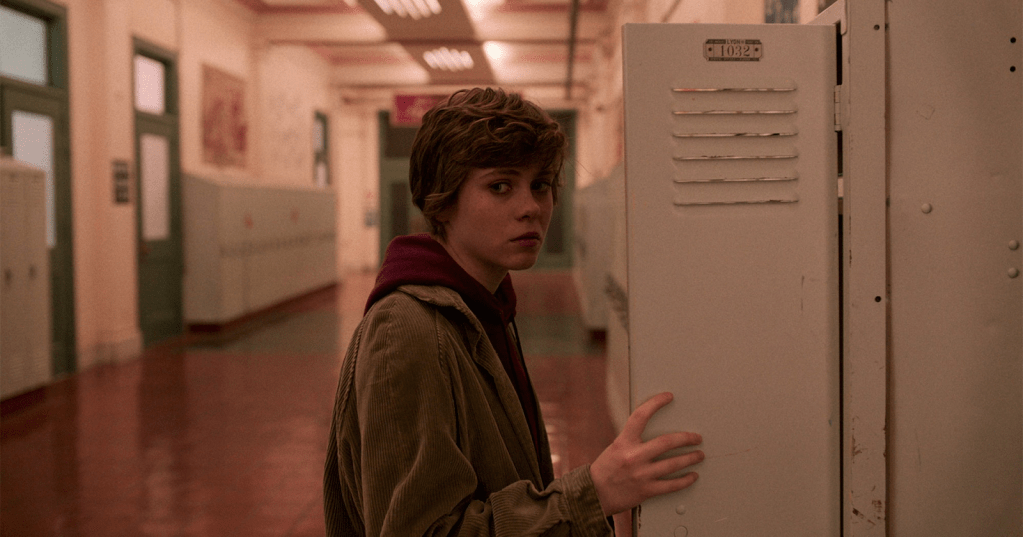
Syd from I Am Not Okay With This via Refinery29
Jacqueline Graif
Editor-in-Chief
When you think of the word “gay,” what comes to mind first?
According to a report written by Just Like Us, a young people’s charity based in the UK, around 9 in 10 (87%) of young lesbians report feeling isolated within the last 6 years. This is in comparison to 46% of young gay men, and 54% of young bisexuals who report loneliness, or a feeling of disconnection from peers.
But why specifically lesbians?
There is a deeply rooted oppression still very obviously present for LGBTQ+ communities, where Homophobia continues to reign very true. However, lesbians often unknowingly get the short end of this stick.
Maybe this is due to a historical sexualization of lesbians, or a direct attack from the patriarchy. Regardless, lesbian isolationism is a prominent issue that lacks research or coverage.
A prime example of lesbian underrepresentation and isolation stems from one of the world’s largest streaming services, Netflix. Every single time there is an attempt at mainstream lesbian representation in a television series, Netflix cancels the show after one season. First Kill, a lesbian Vampire TV show, was a hit, getting over 30 million viewing hours in its first three days on streaming, but it got randomly cancelled after one season. I Am Not Okay With This was similarly cancelled after a hit first season. Finally, one of my favourites, Everything Sucks, had another random first-season cancellation. Every one of these TV shows had a lesbian main character who showed no interest in, or a general disgust toward, a male romantic partner. Even Stranger Things leaves Robin with no female interest at the end of the show. Why can’t lesbians experience long-term love or relationships on TV?
Heartstopper may seem like an obvious mention in this instance, but it features two queer men as the main characters. While Heartstopper arguably features some of the best young LGBTQ+ representation accessible on TV, its lesbian characters are only side characters, whose storylines revolve around homophobia or gender identity. Contrarily, some TV shows, like I Am Not Okay With This, don’t even label the main character, Syd, who only shows an interest in her female best friend and is disgusted by male romantic pursuit. This is arguably a more realistic approach to teenage lesbian lifestyles.
My grievances lie in this underrepresentation. Heated Rivalry was one of the hit TV shows of 2025, expressing the love between two men and showing no other queer characters. I loved Heated Rivalry, and I thought it was an important representation for the community as a whole, but I was upset that no lesbian TV show has been received this way. This lies in deep, patriarchal oppression. It seems as though non-sexual lesbian relationships don’t spark any interest in straight women, or straight men, or anyone other than the Sapphic community. Because of this lack of representation or general ‘interest,’ lesbianism continues to be a taboo topic for most.
While gay men face their own issues with homophobia, they arguably benefit from the upper hand of being male in a male-dominated society. In the instance of media, they have had a large number of well-received TV shows and movies. Heated Rivalry, Heartstopper, Call Me By Your Name, and Brokeback Mountain are prime examples. What about big-hit lesbian movies or TV shows? Can you name any super popular ones? Probably not.
Take Chappell Roan for example, whose entire media existence is proof that lesbians are continuously hated or stereotyped. While her music is globally loved, it is mostly separate from her identity. If you heard “Pink Pony Club” on the radio, you wouldn’t know a lesbian wrote it. Yet, being an out and proud lesbian, Roan faces constant attempts at cancellation online. She has been labelled as “mean” or “rude,” which are very typical lesbian stereotypes.
There is this sense of special disconnect that comes with lesbianism. Lots of other identities benefit from patriarchal standards, such as gay men or bisexuals. But […]
“[…] lesbians have zero patriarchal benefit, and are instead completely isolated from their communities.”
When my high school friends would talk about their crushes, I had to sit out. When my friends were settling a debate on whether or not a man is hot, my opinion was not welcomed. I tried so hard to fit in, to like men, but I really just didn’t. Has the patriarchy exerted such power that anyone who is not attracted to men is isolated from society?
As a woman, I already suffer from patriarchal oppression because of my gender identity. But when you add a lesbian identity on top of that, it deepens the oppression, the isolation, the feeling of never being accepted into your community or society. Why can’t lesbians just love without social isolation and shame? When will lesbians get the representation they deserve?


Leave a comment