

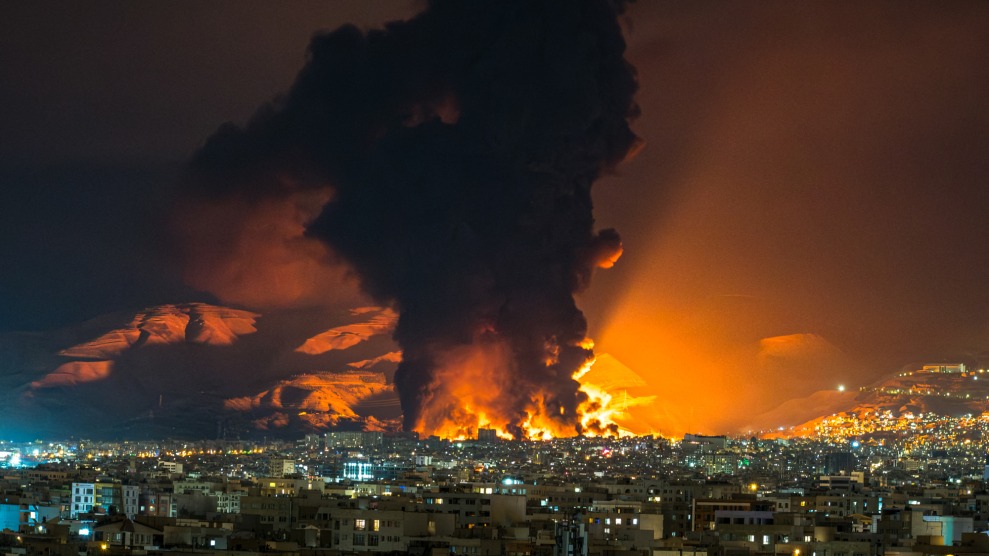
Black rain caused by Israeli strikes on oil storage facilities in Iran.
Via Sasan/Getty Images
By Atika Ume Fazal
News Editor
Conflicts in the Middle East have been a constant throughout most of the post-9/11 world. Whether it be Iraq under Bush, Libya under Reagan, Syria under Obama, or Yemen under Biden, the US’s interest in the region never seems to settle down. Recently, Iran and the United States have found themselves perpetuating this bloody legacy.
The effects of the conflict are felt worldwide, whether countries are directly involved in the war or not. It has had an immense toll on the global economy. Gas prices in countries that get their oils imported have soared to staggering amounts, resulting in the implementation of restrictions and reglementation to curb consumption in many places. To combat the price of barrels that have shot up to almost double during the war, countries have started to encourage people to work from home while others offer public transport free of cost.
The conditions leading up to the war are far too important to overlook. In fact, Iranians had been protesting their conditions strongly starting from the end of 2025. These rallies started as demonstrations against the worsening economic crisis in the country. International sanctions, especially on the part of the US, and governmental mismanagement were weighing heavily on their livelihoods. The Irani Rial, the local currency, dropped immensely, and the inflation rate had reached 52.6% in late December, according to Iran International.
Protesters showed their dissatisfaction with how the country was being run, and the protests turned against the Islamic Regime. Rallies were held everywhere across the country, so far as becoming the second biggest protest movement since the revolution in 1979. The government responded strongly and violently to the protesters. The military took over the streets and did not hesitate to open fire against peaceful protesters. The Internet was shut down for almost an entire month, making communication far harder within the country and with the international community at large. Sources are unclear on the death toll of these protests, with the numbers ranging from 7 000 to 30 000 civilian deaths according to different sources.
The “liberation” of the Iranian people from their dictatorship was a reason brought up by Trump when explaining their intervention. Another major reason used to explain this war was the belief that Iran was developing nuclear power and weapons of mass destruction. US officials have clearly stated that the goal of this campaign is to destroy Iran’s military capabilities, and talks about their nuclear programs have resurged as a main talking point. International Relation professor, Dr. Nazir Hussain, claims that Iran does, in fact, have a nuclear program that it develops, but Iranian officials continuously claim that it is solely for peaceful purposes.
More recent events offer another explanation for the war. Joseph Kent, one of the top officials for counterterrorism in the United States and a big-time supporter of Trump, resigned from his position on the 17th of March. He claimed that “Iran posed no imminent threat to [the] nation” and that the US had involved itself in the war “due to pressure from Israel and its powerful American lobby.” Kent further declared in his resignation letter that he “cannot support sending the next generation off to fight and die in a war that serves no benefit to the American people nor justifies the cost of American lives.”
The war was started on the 28th of February by an immense “shock and awe” type attack on Iran by US-Israeli missiles.
The Pentagon claimed that twice the amount of firepower was used in this attack than on the similar one in Iraq in 2003. The 900 or so strikes managed to kill many high-ranking officials, including the Head of State, Ali Khomeini, and the commander of the Islamic Revolutionary Guard Corps (IRGC), Mohammad Pakpour.
The retaliation by Tehran, the capital of Iran, was almost immediate. They launched a hefty response, with hundreds of missiles and drones being launched into Israel and US-affiliated places. Most of the Gulf countries, all home to US military bases in the region, have been struck by the Iranian military. Airports, oil fields, landmark sites, and US embassies have all been targets in the Iranian response, according to ACLED. Airports and many oil fields in the region have had to shut down, swaying their economies strongly. Israeli military reports on the other hand show that up to 400 strikes were attempted on the country up until March 23rd.
Iran strategically blocked the Strait of Hormuz, vowing to open fire on any non-authorized maritime vehicle that attempted to cross it. This relatively tiny crossing, wedged between Iran to the north and Oman and the UAE to the south, connects the Gulf and the Arabian Sea. It is also where 20% of the world’s oil and liquified natural gas passes through, resulting in almost $600bn worth of trade yearly, according to the BBC. The price of a barrel of oil hence shot up, going from $67/barrel on the 27th of February to $99/barrel on the 27th of March.
Less than two days later, Hezbollah joined the conflict on Iran’s side by firing rockets into Israel. Officials from Hezbollah claimed that the reason for their involvement relied on the killing of Khomeini and the constant violation of a 2024 ceasefire deal by Israel. These attacks prompted an immense military campaign by Israel in the South of Lebanon. According to the OHCHR, more than 700 000 people were displaced in Lebanon, in the first half of March, due to the ground invasion by the Israeli army, 200 000 of which are children.
Civilian lives were lost all around the region. Al Jazeera reports that US-Israeli attacks had killed around 1 330 people in Iran in the first week. One of the strikes that captured the attention and disdain of many happened in Minab, a city in the South of Iran. This attack, the deadliest one yet, hit an elementary school in the morning of the first day of the war. On top of the absolute destruction of the school’s building, this strike—that Amnesty International argues could and should have been avoided—took the lives of over 168 people, including 100 children. According to The New York Times, the school was targeted based on outdated information that characterized it as an IRGC base.
Week two of the conflict showed no light at the end of the tunnel for any of the countries. Israel continued its bloody ascent into Lebanon, causing hundreds of deaths and almost a million displaced people. Iran also continued its relentless military operations in Israel and around the region, hitting civilian areas such as shelters and causing the death of at least 10 people throughout the whole conflict. Increasing amounts of countries got involved in the turmoil, which caused them fear for their own safety. An example of this is a British military base in Cyprus being struck by an Iranian drone on the 9th of March.
That day before, Israel Defense Forces struck four oil storage depots in Iran, submerging the city of almost 10 million people in dark clouds that produced black and oily rain. This attack not only weakened the country’s resources, but it also weakened most of the population. Iran’s Foreign Ministry’s spokesperson called it “intentional chemical warfare.” Citizens were told to stay inside since breathing in the dark smoke is a huge danger to the respiratory system, and the rain could cause serious chemical burns. Peter Ross, a pollution specialist, also told CBC the potential long-term consequences of such an ecological and health disaster. He claims, on top of the respiratory and lung problems, this toxic rainfall could infiltrate waterways. Considering the high-level threat it poses on the exterior of our bodies, carcinogenic potential on the inside is a serious concern for the citizens’ future.
Another cause of concern for the international community came on the 8th of March in the form of a new leader. The late Ali Khomeini’s second son, Mojtaba Khomeini, was selected by Iran’s Assembly of Experts to take the place of his father. Though he had not directly been involved in politics beforehand, he is believed to have been a major figure as an aide to Ali Khomeini. CBS News claims that he had “been involved in running parts of the state apparatus,” whether it be through his strong connections with the IRGC or continuous help within political institutions. He remains private, with little information known about him, drawing skepticism from most international and local entities.
Week 3 intensified the already overbearing energy crisis that had been staggering the region. Israel attacked South Pars, the world’s largest natural gas reserve that is found between Iran and Qatar. This gas field is the biggest source of energy for domestic purposes and any loss in it, according to CNN, would cause immense distress to the population. The attack put immense pressure on the already soaring prices for gas, causing it to climb further. In retaliation, Iran struck Qatar’s part of the South Pars. Considering Qatar supplies the world with a fifth of LNG (liquefied natural gas), the global effects of those strikes were huge.
The situation in the middle east and its effects on the world are still ongoing.
- Week 4: Washington moved thousands of troops to the Middle East, while simultaneously claiming that Iran was “begging” for a ceasefire deal.
- Week 5: Yemen’s Houtis held true to their promise of support for Iran, launching missiles at Israel. They also maintain their threat of closing up the Red Sea if necessary.
- Week 6: The US struck down a bridge right in the middle of it, causing 8 deaths and at least 100 injured.


Leave a Reply