

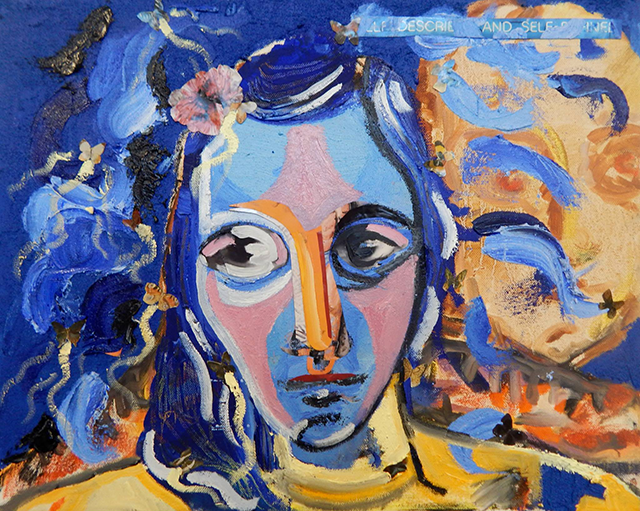
“Defined and Described” by Uma Oswald, via MinnPost
Martin Kaloshi
Science and Environment Editor
The artwork featured in this article depicts the personal experiences of artists who have lived with psychosis.
Around 3 in every 100 people will experience a psychotic episode, according to Yale Psychiatry, either as a byproduct of schizophrenia, schizoaffective disorder, bipolar disorder, severe depression or PTSD, or without any underlying psychiatric condition at all.
Psychosis is the collection of symptoms which alters a person’s perception of reality. Someone undergoing psychosis may find their thoughts becoming jumbled or incoherent. Delusions—firm beliefs in something that is false—are common. One may be convinced that the government is targeting them, that someone else is secretly in love with them, that they are a famous celebrity, that their partner is hiding something from them, or other baseless convictions which no amount of logic or reasoning can debunk. These examples come from Cleveland Clinic’s types of delusional disorder.
Auditory and visual hallucinations are another defining feature. The hallucinating person will see, hear, and sometimes also feel, taste, and smell things that are not actually there. Falsely hearing sounds is the most common type of hallucination, according to the University of Florida. Here, the psychotic person may insist on voices—negative, neutral, or positive—that are not present. These can command, insult, and torment relentlessly. They can also be more benign.
The experience of psychosis varies greatly from person to person—and from culture to culture.

“Self Portrait 13th June 1991” by Bryan Charnley, via Bryan Charnley
Ian Gold, professor and researcher at McGill’s Division of Social and Transcultural Psychiatry, notes that the content of delusions and hallucinations is culturally attuned. He elucidates that Chinese schizophrenic patients, for instance, may see or hear Taoist and Buddhist gods. One individual, in a study by social scientist Kam-shing Yip, believed he was the chief disciple of the Buddha. In West Bengal, as described by researcher A. N. Chowdhury, a delusion might be being pregnant with puppies: reflecting the cultural belief that dog bites can result in puppy pregnancy in humans.
In the case of migrants moving from one culture to another, the content of delusions will also shift to adhere to local cultural frameworks. Psychologists Kausal Suhail and Raymond Cochrane found notable differences between the delusions of Pakistani schizophrenic patients living in Britain and Pakistani schizophrenic patients living in Pakistan. In comparison, British patients living in Britain were having similar delusions.
This makes sense: I wouldn’t expect any of my family in Albania to hear “O Canada” or smell BeaverTails in their psychosis, should they slip into it. Those images are simply not culturally familiar. They are markedly Canadian.
Gold points out that, in a way, it’s almost paradoxical how psychosis is seen as a break from reality, when those undergoing it actually seem pretty sensitive to the cultural realities around them. And, research from Stanford shows that not only is the content of hallucinations and delusions culturally mediated, but so is their subjective experience.
“Americans, for one, were found to hate their voices more.”
Psychological anthropologist Tanya Luhrmann led the study. In the past, she has worked with homeless and psychotic women in Chicago, evangelical Christians who long to hear the voice of God, and she also co-teaches a class called “Culture and Madness” with psychiatrist Daniel Mason. Her work aims to deepen the cultural understanding of mental illness.
In the 2010s, she studied the experiences of voice-hearers in San Mateo, California; Accra, Ghana; and Chennai, India. Each group consisted of 20 people, all passing the clinical criteria for a schizophrenia diagnosis and hearing voices for over one year. During the study, they were asked about the amount and frequency of voices, what they were like, and what they believed the cause of their voices and illness was.
In the American group, individuals were more likely to use the language of clinical diagnoses. They said things like, “I fit the textbook on schizophrenia,” and firmly believed that hearing voices meant being ‘crazy.’ This fear of being judged as crazy held them back from seeking treatment or being upfront about their voices.
Americans’ voices were also typically unknown and hostile. They told the Americans to do horrible stuff like torture others or themselves. Not one American called their voices positive.
Accra, Ghana is a different cultural and spiritual landscape. Here, there’s a longstanding belief in witchcraft, and an understanding of mental affliction as an attack of evil spirits. In this context, voices are not a clinical side effect or a sign of being crazy, but a war between good and evil.
Half of the Ghanaians called their voices positive, and many of them said they heard God. He was telling them to not mind the evil voices, and kept the voice-hearers company. One person noted: “They just tell me to do the right thing. If I hadn’t had these voices I would have been dead long ago.”
In Chennai, India, voices were characterised as those of kin. Over half heard family members telling them to do the usual stuff: cook, clean, and eat. They sometimes scolded and berated the voice-hearers and at other times gave them good advice. 8 out of the 20 had significant positive experiences with their voices, and some said they were ‘playful.’ Also characteristic of the Chennai sample was the reference to sex, which they viewed as embarrassing.
Luhrmann hypothesizes that the differences in voice-hearing can be attributed to larger cultural differences in the way the mind and self are understood. Americans largely view the mind as a private place and possession. In India, however, the mind is shaped by social processes, through which one strives to keep the mind calm. In Ghana, thoughts are believed to have real moral effects on the world; bad thoughts can actually cause harm. Ghanaian voice hearers were quick to insist that their voices were good.
Beyond being fascinating, Luhrmann’s findings could be clinically important. In an article by StanfordReport, she maintained that changing the way individuals approach their voices could change what they hear them say. Could this mean that voices could be ‘made’ more benign? Surely more research needs to be done regarding alternate therapies.

“The Maze” by William Kurelek, via Bethlem Museum of the Mind
“Considering the cultural context the psychotic individual is situated in can deepen our knowledge of mental illness, what it means to the individual, and how to offer them better care.”
To this day, the causes of schizophrenia, schizoaffective disorder, and bipolar disorder, three psychosis-causing mental illnesses, are unknown.
To some degree, they can be biologically explained (especially schizophrenia, often regarded as the most “biologically examinable” psychiatric condition), and great strides are being made. A 2016 Harvard study looked at schizophrenia-associated variants of the C4 gene, showing that C4 marks synapses to eliminate during brain development. The excessive pruning of synapses could help explain both the reduced thickness of the prefrontal cortex in schizophrenia and the disorder’s typical onset during late adolescence and early adulthood.
At the same time, there are environmental factors, too. Both living in larger cities and being a child of immigrants are correlated to higher rates of an individual presenting with schizophrenia, according to psychiatrists Evangelos Vassos et al. and Jonathan Henssler et al., respectively. Luhrmann has shown that culture then also plays a role in the individual with schizophrenia’s experience.
Mental illness resists simple explanation. While biology and environment might shape its onset and structure, culture shapes the way it is inhabited. So, let us keep thinking and rethinking what it means to be mad: not only within brains, but within worlds.


Leave a Reply