
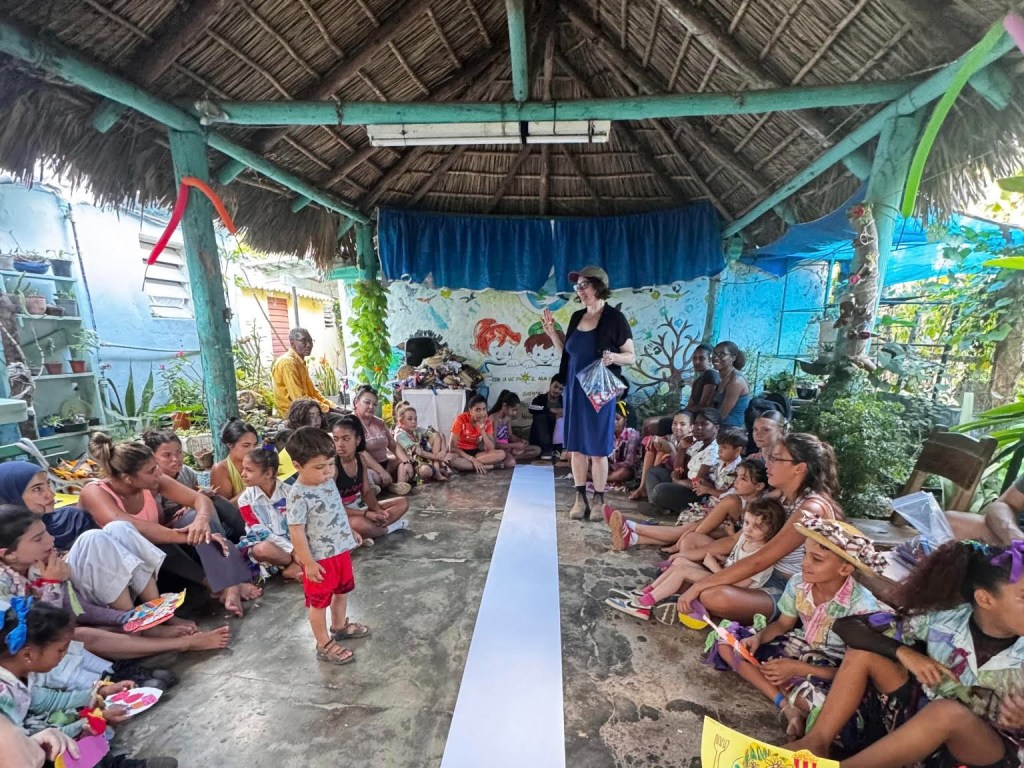
The Social Change and Solidarity students visiting La Camorra Community Project in Puerto Esperanza.
Via Maria Alejandra Acosta Ardila
By Atika Ume Fazal
News Editor
Since January, the almost 11 million citizens of Cuba have received one singular shipment of oil, according to Al Jazeera. The singular Russian tanker provided mild relief to the small island country that has been in a constant state of energy deficiency for decades.
This deficiency is a direct result of the embargo that the United States has put on Cuba. Blockades—whether they be economic, diplomatic, or mediatic—are not a new concept for Cubans. In fact, they have been living under U.S.-sanction for over 60 years, making them one of the longest-running victims of an American trade embargo in history, according to the OHCHR. Yet, the capture of Venezuela’s president (Nicolás Maduro)—the country where a great part of Cuba’s oil used to come from—has amplified the energy crisis there.
After Maduro’s capture by U.S. forces from his home in January, Trump intensified the U.S.’ longstanding embargo. This became a huge source of worry for Cuba. According to CNN, the country relied heavily on Venezuela’s oil and aid packages that the U.S. intervention shut down. Trump continued on to threaten to cut diplomatic ties and impose tariffs on any country that sold or sent oil to Cuba. According to AP News, this move would be made primarily to put pressure on Mexico, a country that has long been a lifeline for the Caribbean state, to further alienate Cuba from other countries. Moreover, Trump continues to threaten attacks and annexation of the country as well, claiming that “[i]t’s possible we’ll make a stop in Cuba after we finish [the war in Iran].”
Fuel shortages have hit Cuba hard—hospitals have had to cancel surgeries, universities have had to reduce classes, and many families find themselves incapable of preserving their food. Mariana Duque, a Social Change and Solidarity (SCS) student at Dawson, provides additional insight on the situation there: “We tend to think that we know what is happening in Cuba, but the scarcity is worse than we think, and it is getting worse. People now have less than 4 hours of electricity per day, and that doesn’t only affect them switching on a light or off; it stops people from taking transport to get to work, worsening their economic situation. They can’t maintain their food in the fridges because it just doesn’t work. Lifestyle becomes harder and it’s not an individual role, [for] Cuba, to do something about it, but rather a global responsibility.”
Organizations and states across the globe have indeed been trying to provide some form of aid. Global Affairs Canada vowed to send 8 million dollars in aid to specifically “strengthen food security and nutrition” within the country.
Sara Louise Kendall, SCS profile Coordinator and Geography teacher, claims Canada should be doing so much more: “Canada has sent 8 million dollars of aid, which is less than a dollar per person on the island. It’s a tiny drop compared to the aid that Canada sends elsewhere. Canada could have given more aid. Canada has oil, Canada can send oil. Canada should denounce the blockade. Canada should deepen economic ties with Cuba. There’s so much that Carney could be doing to live up to the values that he got celebrated for saying at Davos. And we’ve seen very, very little.”
A lot of the humanitarian work has been done through grassroot international organizations, the Nuestra America Convoy being a prime example of it. They describe themselves as “an international coalition of individuals and organizations dedicated to delivering critical humanitarian aid to the Cuban people,” and accomplished a big part of their mission in March. 650 delegates from over 33 different countries—including Brazilian activist Thiago Ávila, Irish rap-trio Kneecap, and American streamer Hasan Piker—managed to bring over 20 tons of humanitarian aid to the island. According to AP News, the aid consisted mainly of medicine, food, solar panels, and hygiene products.
At Dawson, especially in the SCS program, the fight against American imperialism stays constant. Their yearly solidarity trip to Cuba allows them to bring countless products demanded by their Cuban associates on the ground. Kendall talks about their last trip: “We brought 23 suitcases filled with donations, and that was a mix of [different things]. For a youth organization, they had requested costumes and toys and sports equipment, but it was mostly medication. So we purchased a bulk order of 300 pounds of medications from an organization [to bring to Cuba].”
The activism on their part doesn’t stop there. Locally, they have assisted numerous Table de concertation de solidarite’ Quebec-Cuba meetings that allow for different organizations concerned with the situation in the Caribbean country to find a voice. Moreover, they have produced a petition, made by students for students to sign, in order to make demands from the government regarding the embargo. “We’re […] making it known that we are fighting, and we want more justice for Cuba, especially knowing that so many people from Quebec are always going there to vacation. But when it’s time to actually help the people you depend on, we don’t do it,” saysAnna Gueye, also part of the SCS program.
One of the most basic things the students find themselves advocating for remains education and awareness on the matter. Duque insists “Cuba is more than just a communist narrative like the U.S. tries to paint. Cuba is a country, and there are human beings living the cost of imperialism by the US.
By us ignoring the issue, it legitimizes the fact that it’s an ongoing blockade. And it has been for more than 60 years.”
“There’s no way you can justify the way they’re being treated,” adds Gueye.
Cuba’s socio-economic situation continues to evolve, and as the students urge, it stays imperative to keep an eye on it.
Thank you to Sara Louise Kendall, Mariana Duque, Anna Gueye, Chloe’ Cauvin, and Maria Alejandra Acosta Ardila for providing insight into the SCS program and its missions.


Leave a Reply