
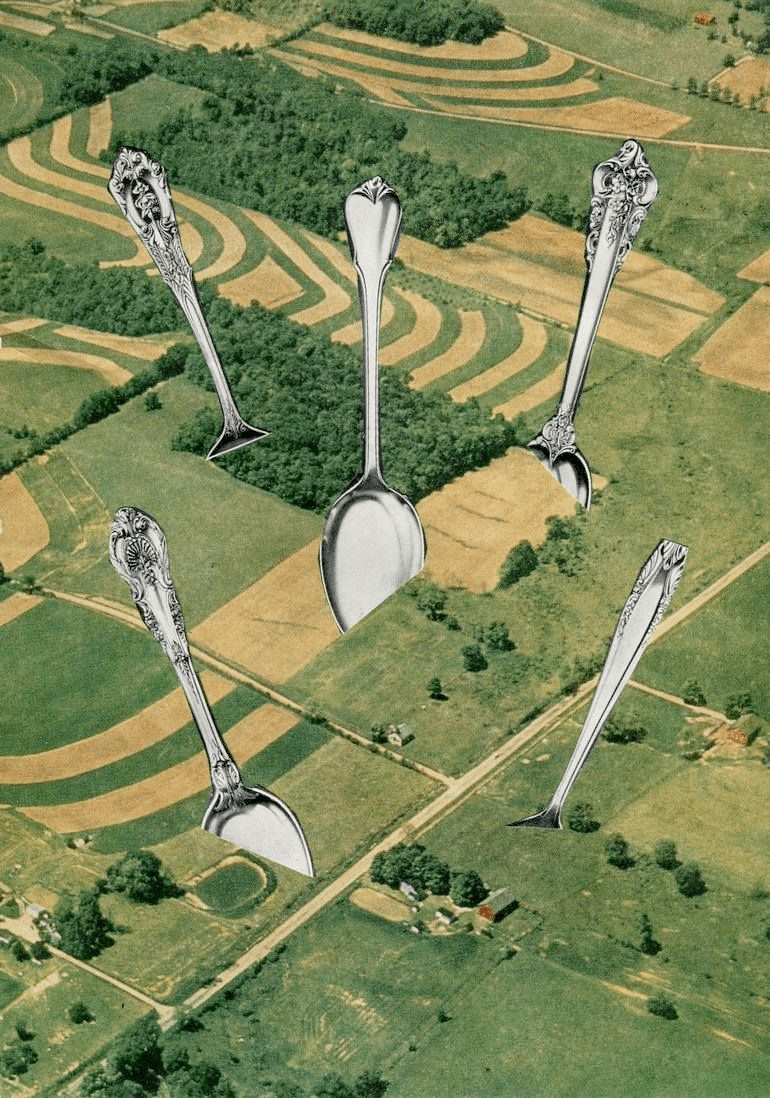
Collage via Maya Land
Simone Mudie
Visual Arts Editor
Every day, you wake up and probably have a cup of coffee, breakfast with maybe some berries, cereal, or even bacon. But, are you aware of where all those grains, meat, and fruits come from?
One of the biggest impacts of globalization is the somewhat taken-for-granted reality of global food trade. Our grocery stores hold rice from India or China, avocados from Mexico, bananas from Brazil, and coffee from Ethiopia. As for local products, do we recognize the people, energy, and resources it took to extract your local wheat or red meat? Many of us are not aware of how food got on our plate, or that about a third of all human-caused greenhouse gas emissions are linked to food.
Subsistence systems are the ways in which a society acquires and gathers its food; it encompasses the skills, technologies, and cultural norms used to feed a community. Canada, and most of the world now, are agricultural societies. We separate the act of production from that of consumption, contrary to some societies whose everyday practices are intrinsically tied to their ways of getting food. Through globalization, we have become less and less aware of our subsistence systems; and the way the crops are returned to our plate is more delayed than ever. Does this narrow perception of our food’s journey allow us to truly know the ways in which it affects our environment, or reversely, the ways a changing environment affects our food resources?
Indeed, the United Nations states that a third of greenhouse gas emissions come from cattle’s digestive processes (their population numbering today at around 1.5 billion heads according to HYDE database of the UN), such as fertilizers used in crop production, carbon dioxide from deforestation, and farmland expansion; and other factors like manure management, rice cultivation, and burning of crop residue. While there is a fraction of this ⅓ that comes from transportation, packaging, and food waste, it is a significantly smaller share than we might tend to believe.
Meat production is the most harmful agricultural production, as it demands extensive land, produces lots of waste, and needs substantial amounts of fertilizer for the production of cattle feed. Something that we often forget is that animals too need to be fed, creating a whole new population to produce for. Indeed, while 363 million people are at risk of acute hunger in 2026, according to the World Food Programme, around 21.4 billion chickens and 1.5 billion cows are being fed everyday. By simply being aware of the impacts of food on our planet, we can try to eat more mindfully (but let’s not forget this is not our fault as individuals, but rather it is on the back of the big food corporations and monopolies, who control this production that affects our earth ).
However, food resources and production are set to change significantly with climate change. By 2025, food demand could go up by between 59 to 98%, according to the Columbia Climate School. This would mean that we need to increase production, which is becoming harder and harder with the changing climate. Proceedings of the National Academy of Sciences conducted a study which concluded that vegetable and legume crops yields would be cut by 35% by 2100 if environmental changes, like emissions, climate change, air pollution, water scarcity (or flooding), and salinization (caused by continuous cropping), follow their current trend; this could be affecting crops yield all over the world. The PNAS report also states that every increase in degree Celsius will in turn cause a 5 to 15% decrease in worldwide crop production. Climate Data Canada also documents that climate change will enable certain weeds, parasites, and crop pests to thrive in new environments, as a fluctuation in temperature allows for a bigger territory for these parasites to boom.
Other factors that greatly affect our food access, especially today, are politics and active wars. The wars in Iran and West Asia are affecting our North American, and global, resources for food. The Strait of Hormuz carries a significant share of the world’s energy and agricultural input. Máximo Terero, chief economist of the Food and Agriculture Organization, explains how 20 to 30% of the world’s fertilizers are not moving in the supply chain since the blockage of the strait. This supply bottleneck could result in a crisis, and agriculture producers may have less access to fertilizers, thus creating lower yields for the next harvest.
The PNAS claims that research about the environmental impacts on our food and crop yields are, for the moment, very limited. They highlight how further understanding of the scale of environmental impact on global food production is essential to protect our population’s health and access to food. It is important to remember that none of this is our fault. Sure, we can participate in some ways or others, but at the end of the day it lies in the production corporations who would benefit from looking at the science.


Leave a comment