

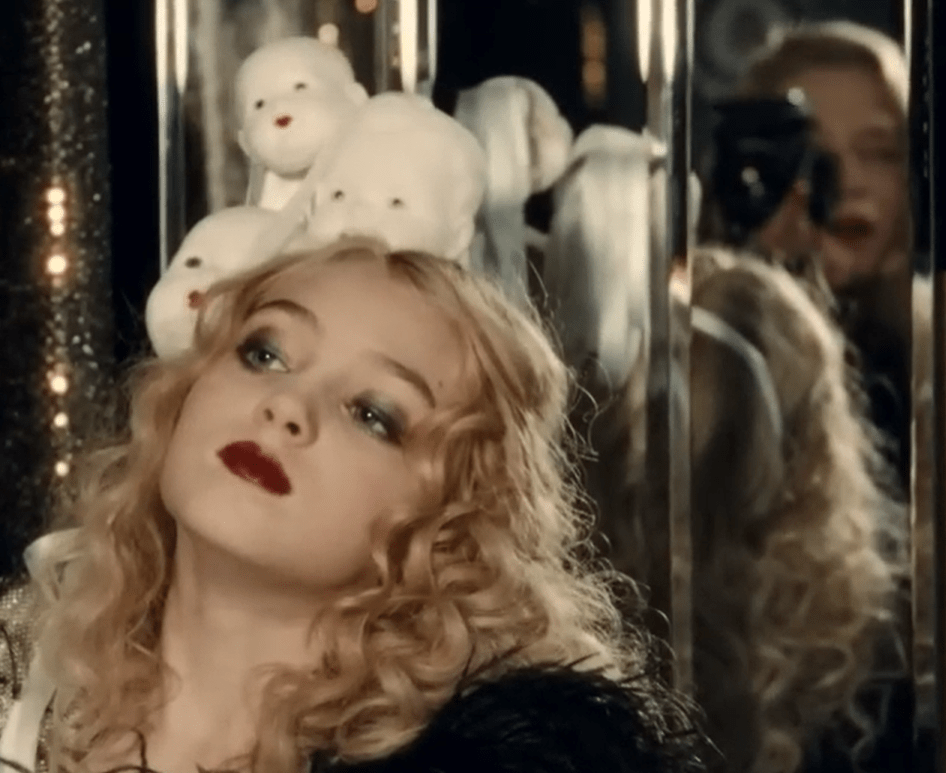
Via My Little Princess (2011)
Minola Grent
Editor-in-Chief
Every story has the right to be told. Even difficult stories of abuse and manipulation do. So, with an asterisk: leave the children out of this.
In the midst of the 1970s cultural confusion, Franco-Romanian photographer Irina Ionesco turned her daughter, Eva, into her muse. Harmless, right? Well, the catch lies in the nature of Irina’s style; she was known for her baroque and erotic photographs emphasizing the female figure.
From ages 4 to 12, Eva was posed and photographed nude just like all her mother’s adult models. In the name of “art,” Eva had been naked on the covers of Playboy, Penthouse, and Der Spiegel magazines by the age of 11. The horror Eva lived through did not end once she was removed from her mother’s custody in 1977, when she was just 12-years-old. By the time she turned 13, Eva was the ‘70s’ Parisian night-life sensation as clubs, drugs, and sex became her second home. She was stuck in the vicious cycle her mother placed her in.
Eva eventually found solace in the arts and shared her life experiences through movies and books. One such movie sparked international discourse: My Little Princess (2011). This semi-autobiographical exploration of Eva Ionesco’s childhood and relationship with her mother wants to be, as Eva explained to L’Express magazine, a “monstrous story, but [told] like a fairytale.” As will be explored with further examples, Eva Ionesco’s words perfectly depict a common but no less dangerous standard for the representation and denunciation of child sexual abuse, grooming, and pedophilia in contemporary media.
For My Little Princess (2011), actress Anamaria Vartolomei stepped into her first acting role as Violetta, a 10-year-old girl whose mother begins taking erotic pictures of her. The aforementioned characters represent Eva Ionesco, the director, and Irina Ionesco, her mother. On the positive side, Eva offers excellent criticism of the ‘70s’ art scene and hypocrisy of those who engage with or defend it. In the movie, during a public art exhibition of Violetta’s pictures, a female attendee exclaims: “J’aime le décalage entre l’immaturité du corps et la perversité du regard.” This comment objectifies, corrupts, and sexualizes the image of Violetta’s childhood through an adult’s point of view.
Hanna (Isabelle Hupert), Violetta’s mother, is at the center of this objectification of her daughter. She repeatedly rebukes her daughter’s concerns or protests by reminding her everything is art. For example, when Hanna first asks Violetta to uncover her genitals in a photograph, she protests, saying, “Je ne veux pas [être] toute nue, je n’ai pas assez de poils. On verra que je suis petite.” In response, her mother scolds her: “C’est ça qui est somptueux […] On dirait une fleur vénéneuse. C’est ça qui est beau.” Her mother continues to shame her daughter, calling her prudish and uptight until Violetta gives in.
Actors are often criticized for being too recognizable in a film, unable to disappear behind the character, which effectively breaks the viewer’s immersion in the story. In the twisted case of Vartolomei’s work on My Little Princess (2011), it is not the actress’ face or past movies that make the watch uneasy—this was her acting debut—but rather her age. Anamaria Vartolomei was only 10 years old during the filming of My Little Princess (2011).
Suddenly, the scenes during which Violetta sits on the laps of older men and kisses fictional English rockstar Updike, played by 20-year-old Jethro Cave, turn sour. Vartolomei fails to disappear behind the character of Violetta, not by any fault of her own, but because of the unease the audience can’t shake throughout the movie.
“The line between fiction and reality blurs when it isn’t just 10-year-old Violetta, the character, being placed in these inappropriate situations, but also 10-year-old Anamaria, the young actress.”
She is put through scenes like sitting on the laps of older men and kissing 20-year-old Jethro Cave as he grips her chest and waist, until the take is just right.
Very few interviews with Vartolomei and Eva are available regarding this movie and only one of them inquires into Vartolomei’s experience. In 2024, at 25 years old, she tells Le Mag Cinéma that she was very prepared for the role because Eva insisted she be fully aware of all the emotions she’d have to portray and the difficult situations in the script. “J’avais complètement conscience de ce que j’étais en train de jouer,” she tells Le Mag Cinéma. She describes her personal life at the time as quite healthy and explains that, for this reason, she found Violetta’s situation and hypersexualization to be simply intriguing rather than traumatic.
Yet, Vartolomei seemingly contradicts herself in the following question regarding her parents’ role in her casting and performance in My Little Princess (2011). She talks of the innocence that accompanied her first acting experience and how little she knew. Vartolomei recounts her short-lived belief that her work was done after the first day of shooting when, in reality, she still had 40 more days to go. She says, “Comme je débutais et que je n’avais aucune conscience du fonctionnement de l’industrie, mes parents ont été très utiles, parce qu’on l’a découvert ensemble.” Vartolomei insists on her parents’ positive influence and commitment to protecting her on set.
However, despite all the precautions taken both by Eva and Vartolomei’s parents during casting and on set, could a 10-year-old child have truly understood and consented to appearing in her underwear and being depicted as a seductress?
Eva Ionesco’s cinematic retelling of her sexualized childhood is disturbing, not just because of the narrative, but because it also fails at protecting child actress Anamaria Vartolomei the way Eva would have certainly liked to have been protected at her age.
Though the film ultimately brings awareness to the negative effects of Hanna’s photography and sexualization of her daughter, its artistic direction causes more harm. On 5 separate occasions, which span over 15 minutes of the movie’s 1 hour and 40 minute runtime, the viewer is presented with elongated sequences of Hanna photographing Violetta in suggestive clothing and, oftentimes, downright pornographic poses. This does not include other scenes during which Vartolomei acts like a ‘mini femme fatale’ or like a ‘femme-enfant,’ culturally known as a “Lolita.”
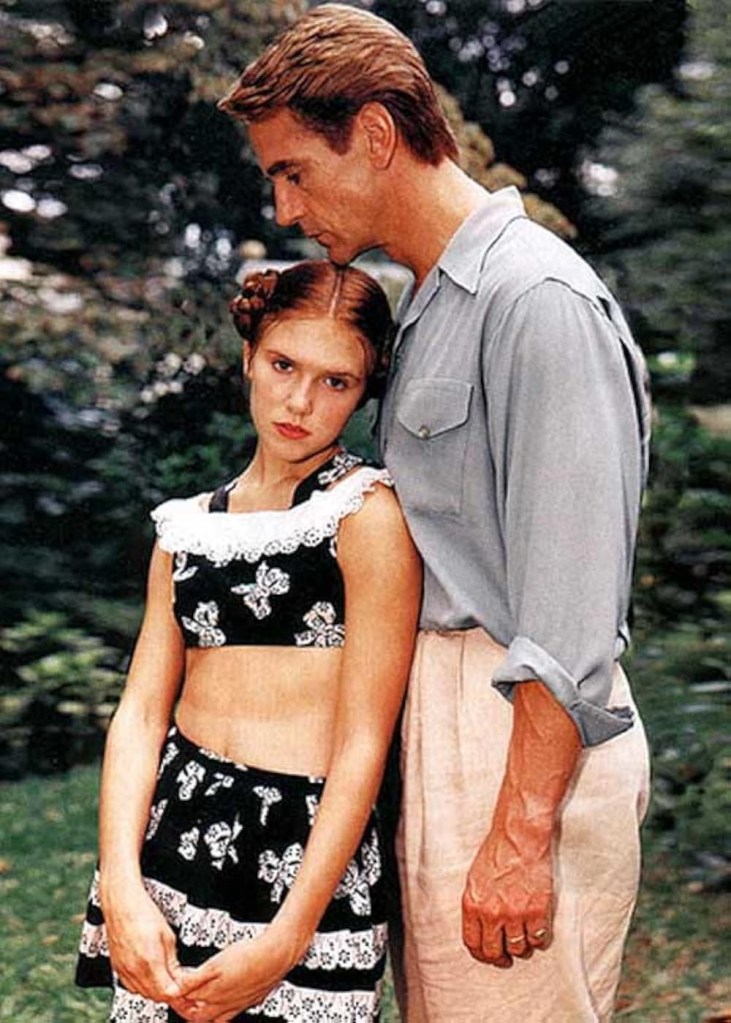
Lolita (1997) Via IMDB
This term, describing a nymph-like female child that is aware of her sexuality and uses it to attract men, was introduced by Vladimir Nabokov in his 1955 novel Lolita. Nabokov’s book follows Humbert Humbert, a French man in his late thirties, who marries a widow because of his infatuation with her daughter, Dolores Haze. Over the course of 36 chapters, Humbert kills Dolores’ mother, kidnaps the 12-year-old little girl, and, using her grief and fear, traps her in a pedophilic and pseudo-incestuous relationship.
The book is a masterpiece in first person perspective work, immersing the reader directly into the twisted mind of Humbert as he endlessly justifies his actions. The manipulation the reader is subjected to bleeds through Humbert’s voice. Nabokov depends on the adult consumer’s good moral judgement to be disgusted and appalled. Lolita (1955) was given two adaptations throughout the years: one in 1962, in which 14-year-old Sue Lyon played Dolores Haze, and one in 1997, in which 15-year-old Dominic Swain portrayed her. In both, Nabokov’s intention is lost through the change of artistic medium. Humbert’s sugarcoated abuse of Dolores as the unreliable narration loses its impact on the screen, where subtleties of this kind are difficult to achieve. Worst of all, this story depends on the public recoiling at the simple sight of a young girl with an older man, which cannot be achieved without a child actress.
Therein lies the contradiction that makes a faithful and ethical adaptation of Lolita (1955) and future abuse stories impossible.
“How to portray Humbert and Hanna’s perversity, sexualization, and graphic abuse of Dolores and Violetta without compromising the mental health, image, and dignity of a child?”
In the case of Sue Lyon’s Dolores Haze, the filmmakers wanted to market the young actress as the sexualized object that Lolita is portrayed as in the movie and to make Lyon indistinguishable from her character, says The Teen Mag. The press’ distortion of the character of Dolores Haze and Sue Lyon watered down the message of the movie. The Teen Mag even reports some critics calling Lyon a “deceitful child-woman” and saying that “Humbert’s desire for her comes off as ordinary.”
“My destruction as a person dates from that movie. Lolita exposed me to temptations no girl of that age should undergo,” later said Sue Lyon.
Though Dominique Swain didn’t express similar sentiments regarding her experience with the character of Lolita, Andrian Lyne’s publicly stated perception of his movie as a love story taints the 1997 adaptation’s making and reception.
My Little Princess (2011) and all Lolita (1955) adaptations have failed to assure a safe environment in the process of bringing awareness to infantile sexualization. Certain stories don’t belong on a screen because the physical projection of sexuality on a child is enough to endanger them and their image. Remember, children cannot consent, even for playing pretend.


Leave a comment