

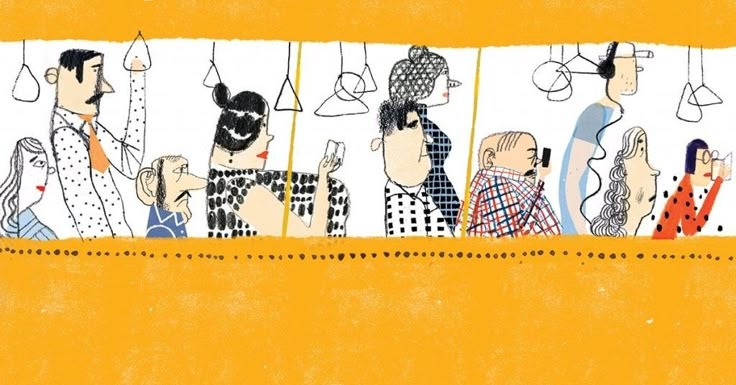
Illustration by Victoria Semykina
Orla Jeanes
Staff Writer
As my train pulled out of Union Station, bringing me home from an Easter weekend in the midst of Toronto skyscrapers, one of the first things I noticed about my surroundings was the overt lack of conversation. Besides the mechanical humming of the engines, and the occasional murmur of the PA announcing approaching stops or, unsurprisingly, apologizing for delays, the six hours it took to make the journey back to Montreal were almost entirely silent. With most of their gazes fixated on some form of device, it seemed as though my fellow passengers could not be bothered with the idea of idle chit-chat. Given my similar predicament, occasioned by the bright laptop screen sitting in front of me, I could hardly pass judgement. That being said, I couldn’t help but find it somewhat strange that seemingly no one was choosing to pass the time conversing with their seat neighbour.
Had I just so happened to find myself in a train filled exclusively with introverts? Were they, like me, urgently attending to neglected Perusall assignments for their philosophy class? Or was this perhaps part of a greater trend, one in which people seem to be generally more inclined to keep to themselves than to socialize with those around them?
At its inception, the Age of Digitalization was full of promise as to the future of communication. Gone were the days of shared landlines and indeterminate meet-up plans; instead, it had suddenly become possible to contact whomever, whenever, wherever, all but with the simple click of a mouse or the quick tap of a screen.
Engrossed by the novelty of this burgeoning internet realm, we hardly noticed the silence that was encroaching upon our daily lives. Paradoxically, the very devices that offered us this incredible ability to reach anyone we so desired in a matter of seconds were also causing us to retreat into self-inflicted states of solitude. Rather than thrive from a newfound accessibility, our propensity to socialize had found itself placed under threat.
“As it happened, modern technology has more commonly been relied on as a way to escape spoken interactions than as something that can facilitate them.”
In public spaces specifically, the ubiquity of electronic devices has had a deadening effect. Whether it’s in waiting rooms, lineups, or apartment building hallways, people come across as more taciturn, appearing almost as if they are purposefully avoiding eye contact. With most of their attentions diverted, either by some forbidding screen blocking their face or a pair of noise-cancelling headphones tuning out the world around them, their use of technology only serves as a tool to ward off potential conversationalists. Propelled by the restrictions of the COVID-19 pandemic, the tendency to keep to oneself has grown exceptionally popular and, seeing as we are creatures of habit, the act of striking up a conversation has resultantly become more challenging. Held back by fears of awkwardness, of judgment, or even of rejection, our attitudes towards socializing, especially with people we don’t really know, have largely turned cynical.
But what about when we do find ourselves, unexpectedly, having a one-off chat with a stranger? Maybe it was with an old man who, while waiting for the bus, felt compelled to share a friendly anecdote, or maybe it was the girls who complimented your outfit in a graffitied bathroom on a night out. Regardless of the exact circumstances, we all inevitably collect stories of such exchanges in which we’ve deviated from our habitual circumspection. And, for the most part, we look back on these memories not with embarrassment or discomfort, but rather, with fondness.
Although fleeting, these anomalous interactions strangely leave their mark, crystallizing in our minds as warm and vivid recollections that stand out amidst a backlog of routine conversations with friends and family. For a few minutes, we are drawn out of our technology-induced introversion and reimmersed amongst fellow human beings, an experience the Canadian psychologist Gillian Sandstrom refers to as being “woven into the fabric of [our] community.” Not only conducive to a better mood, random, micro-moments of connection remind us of our shared humanity, making individuals more empathetic and less bent towards prejudice. Most importantly, to counter the silence that is slowly fragmenting our society, these kinds of interactions are essential in keeping our social network alive—that is, the offline one.
In the end, as my train finally neared our Gare Centrale, exhausted as I was, I still managed to make note of a conversation that had materialized nearby. Just a few seats over, a McGill freshman was explaining his struggles to learn French to an attentive, older québécoise woman. From his unassuming confessions to her well-disposed tips, this heartwarming scene of one stranger opening up to another served as a reminder that, however disheartening the state of our social skills may be, the silence is breakable.
And, as it turns out, every now and then, we do break it.


Leave a Reply