

Via Pinterest
Alaa Ettaouth
Staff Writer
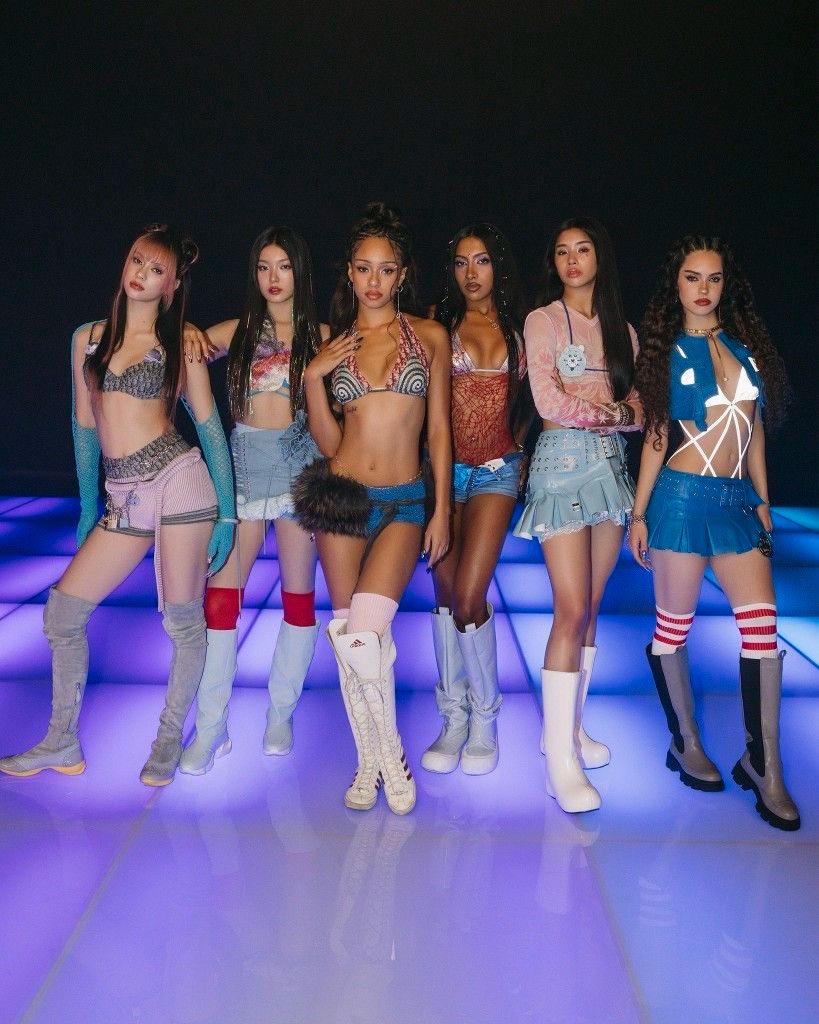
In February 2026, Manon Bannerman, member of the global girl group KATSEYE, halted her activities to “focus on her health and wellbeing,” according to a joint statement from labels HYBE and Geffen. This announcement sparked a visceral reaction in the K-Pop community because it seemed to contradict the personal message of Manon to her fans: “Sometimes things unfold in ways we don’t fully control, but I’m trusting the bigger picture.” Discourse immediately started to intensify online, stemming from fans’ allegations of Manon liking Instragram posts suggesting that she was another victim of the “the lone Black girl in girl groups” trope. Furthermore, Manon’s categorization as “lazy” in the reality TV show Dream Academy, where 20 candidates competed in missions to form an international girl group, KATSEYE, has been following her like a shadow.
Manon is not an isolated case of the deeply flawed K-Pop industry. She is rather a blatant example of how modern K-Pop has been treating Black culture and the bearers of its art since its emergence in the late 1900s.
American music first made its way into Korea at the end of the Korean War in 1953 via the many military bases and “camps” set up in small towns all over the country. Because of their close proximity to these bases, the towns provided one of the earliest introductions of African-American music to South Koreans. In their quest for freedom after a disastrous war, Korean music shifted and molded into a mosiac, inspired by many genres. Koreans adopted soul music, rock ‘n’ roll, and even psychedelic rock, musical genres originating from Black traditions.
The inspiration exceeded the mere borrowing of Black musical history, it completely shaped how the modern Korean-pop industry opperates and creates its musical scenery. As a matter of fact, the “idol” culture that sets K-Pop artists apart from Western musicians originates from Detroit, a predominantly African-American town. Motown Records was founded by Berry Gordy in 1959, an era marked by racial discrimination. This corporation managed to attain a fulgurious commercial success by producing a record number of chart-topping artists, including Diana Ross and the Supremes, The Jackson 5, Stevie Wonder, and Marvin Gaye.
What made the Motown Records label so unique was its Artist Personal Development Department that sought to help young inexperienced artists with talent to develop their presentation style, celebrity etiquette, poise, and choreography. Does this ring a bell? For J.Y. Park, founder of JYP Entertainment, a leading South Korean entertainment company and record label, it certainly reigned true. Park has credited Gordy’s work as an inspiration for the development of his own musical prospects. In a 2022 interview for his new international show, America to Korea (a reality TV show where American artists are trained using the K-Pop system), Park declared that he started his company based on the American model of Motown Records, influenced by how they trained raw talent.
Motown was ahead of its time. This record label saw music as not only something music enthuasts could consume, but also as a personal bridge between a fan and an artist. The marketing strategy from the Motown era included: creating polished album covers, offering exclusive fan items (such as photocards), and closely monitoring the creative steps all under one roof, the Hitsville U.S.A. This was all part of a larger goal to make the fans personally resonate with the artists, and it is a strategy that has since defined K-Pop labels’ marketing approaches.
Unfortunately, even if K-Pop’s history is intrinsically intertwined with Black music practices, Black artists were never genuinely valued in the artistic process of creation. Often, labels and groups have no shame in wearing Black culture as a costume to sell a certain image, usually one that is sterotypical. In the early ages of BTS, the biggest boy band in the world, their concept was heavily inspired by hip-hop music. There were many instances of RM (the group’s leader and main rapper) wearing dreads, using AAVE (African American Vernacular English) in his rapping, even going as far as employing the N word in a cover of SHINHAW’s song “T.O.P” (another K-Pop group known for unapologetically appropriating Black music…) More recently, ALLDAY PROJECT’s “Tarzzan” (his real name being Lee Chae-won) has been under fire for wearing protective Black hairstyles, showing off grills, and for his poor attemps to rap; profiting off Black culture without ever really interacting with the roots of the culture.
“The “coolness” K-Pop artists want to embody so desperately is done by usurping Black cultural identity and voids all the historical meaning that defines it.”
K-Pop appeals easily to its audience because it offers a watered-down version of Black American music: K-Pop strips Black American music from its social context, making it more digestable to listeners who do not necessarily want to interact with the historical bagage Black music carries.
Nonetheless, the history of African-American music is an important story of resistance and survival. When Black people raised against the racial segregation during the Civil Rights Movement from 1954 to 1968, songs were used in protests and heavily influenced Soul music . In order to persist, marginalized communities had no choice but to create their own sub-cultures when the majority drastically rejected them. Hence, it is crucial to never dissociate the struggles and the fights that led to the blooming of African-American art forms, distinct styles and sounds. I sincerely hope that the awareness around Manon’s case will serve as a first step to better recognize the work of Black artists in making the K-Pop industry the commercial success it is today.


Leave a Reply