

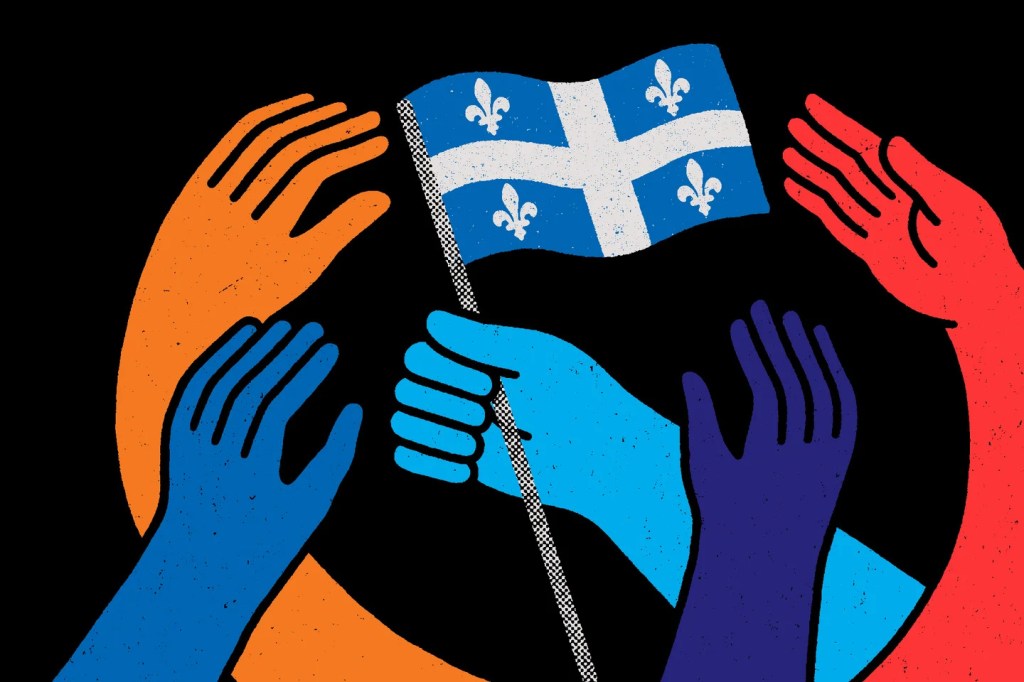
Illustration via maxprevo
By Atika Ume Fazal
News Editor
Quebec finds itself at the eve of what could be a huge change in politics.
On the 27th of August, Quebec’s National Assembly was dissolved, calling elections for the 5th of October.
For the past 8 years, the Coalition Avenir Quebec (CAQ) has been winning decisive victories. In 2018, the party secured 74 of 125 seats, with the Liberal Party winning 31 to form the official opposition. In 2022, the CAQ’s seats increased by 16, bringing its total to 90 andproviding them with another majority government.
For almost the entirety of the CAQ’s tenure, Francois Legault was the leader of the party. He stepped down on the 14th of January 2026, leading to Christine Fréchette taking his spot after winning the party’s leadership election.
A study was conducted by The Plant to see what subject students are most concerned about for the upcoming election. These were the results and the promises the main parties have made regarding these subjects:
Cost of living
Students find themselves in a precarious situation regarding their buying power.
“While virtually everything keeps getting more expensive, wages have struggled to keep pace.”
Even with the recent raise in the minimum wage in Quebec, going from 16.10$ to 16.60$, the gap to a livable wage stays enormous.
IRIS calculates that a single person living in Montreal would need an hourly salary of $30.00 in order to be comfortable. Hence, the augmentation of the minimum wage was received with quite a bit of criticism. Jean Boulet, the CAQ’s Minister of Labour, claimed it was necessary to keep a low augmentation in order to be able to provide support to small and medium businesses.
Parties have proposed various solutions in order to combat the cost of living.
The Parti Quebecois (PQ) promises to abolish QST (Quebec Sales Tax) on used goods. Currently, most used goods stores must have the Quebec sales tax on their products. Moreover, they also pledge to propose a bill banning surveillance pricing. This intrusive way of pricing uses personal data in order to create individualized prices for different consumers, explains Emily Osbourne, a policy researcher at the Canadian Shield Institute.
For the CAQ, providing specific groups with financial aid is the solution. Senior citizens and parents are a priority for the CAQ. They pledge to invest 1000$ in the Registered Education Savings Plan of every Quebec-born child from fall 2027 onwards. They wish to abolish income tax on up to $35,000 for seniors who might wish to return to work in essential services that are facing a labour shortage.
The Liberal Party of Quebec’s (PLQ) promises are mostly focused on providing financial and reglementary help to small and medium businesses for now.
Quebec Solidaire (QS) pledges many different solutions to help combat the cost of living. They also wish to abolish Quebec taxes on used goods, as does the PQ. Moreover, Quebec Solidaire pledges to raise the minimum wage to 20$/hour within a year of their mandate. Rising grocery prices on the other hand will be combatted by creating state-run grocery stores, capping grocery margins at 2%, and increasing consumer rights. Furthermore, QS also claims it will make contraception and female hygiene products in public spaces free.
The Conservative Party of Quebec (PCQ) is another party that wishes to abolish the QST on used products. They also pledge to remove provincial tax on gas for five months in an effort toalleviate the financial stress on consumers. Furthermore, the Conservatives want to raise the basic personal account — that is the amount of your income you do not have to pay taxes on — to $35,242, almost double the current amount of $18.952.
Education and Language
Students, especially those from francophone backgrounds who wish to pursue higher education in English, have found themselves in a precarious situation the past few years. In recent years, multiple bills and laws have been passed in the hopes of protecting the French language. This makes it harder for such students to access higher education, and ends up disproportionately affecting newcomers.
Moreover, the state of the education system as a whole has been raising concerns. Experts from Montreal Public Health have recently been flagging the three-tier schooling system — that is to say the system in Quebec that divides education into private, specialized public schools, and general public schools — to increase educational disparity between youth. Of even greater concern,
“Montreal is also the city most affected by a lack of teachers, with over 3% of teaching jobs being vacant according to Le Devoir.“
The PQ pledges to investigate how the French language is affected by cultural exchanges in Montreal and Laval, while reinforcing the language and its rules in classes. They would do this by demanding that 10% of whatever school work be graded on the language. Moreover, they also want to extend the Charter of the French Language to CEGEPs, forcing them to hold a considerable part of their activities in French.
The CAQ, under Fréchette, denies the fact that Quebec has a three-tier education system, even as facts clearly contradict this point of view. They would, therefore, not hold a convention to get an overview of the Quebec school system.
Liberals, on the other hand, claim that they will hold a general convention on the state of education in Quebec, which would provide answers for the future of this sector. They also wish to eliminate the provisions that make it so that English-language CEGEPs have progressively fewer spots for non-Anglophone students, rather choosing to keep a set percentage (15%) of eligible students from francophone backgrounds.
QS also vows to hold a general convention on education. Additionally, they also want to invest $200 million so that every child has a chance to participate in educational projects offered by their school. Ghazal has also promised to establish a common education system, where public and private schools are more accessible to everyone, countering the effects of the three-tier system.
The Conservatives, on their end, seem mostly concerned by physical education courses. They wish to see more of them included in the curricula of CEGEPs, secondary schools, and primary schools. However, we do not have much more information on this plan for the time being.
Sovereignty
Quebec’s independence movement has often been at the core of political life. After two close referendums back in 1980 and 1995, the nationalist movement is shown to be swindling. According to a study by Leger, only 31% of Quebecers look favourably to an Independent Quebec. Nevertheless, a huge surge in interest in the matter has been demonstrated by the youth.
For the Parti Quebecois, the independence movement has always been at its core. They still vow to hold a referendum, yet have introduced a caveat that many other parties criticize. In fact, the PQ has claimed that it will only hold a referendum once Trump has left office. Paul Saint-Pierre Plamondon, leader of the party, claims this is the right way to go about this, for
“[The question of independence] must not be hijacked by the upheavals of American Politics, the attention-grabbing antics of an unpredictable president, or fear-mongering campaigns.”
Quebec Solidaire is the only other party that wishes to hold a referendum on independence. They will hold theirs independently of what is happening at the south of the border. Moreover, Ghazal’s party pledges to create a constitution for the referendum by consulting Indigenous populations of Quebec, something the PQ has not spoken on.
The other three parties will not hold a referendum on independence if voted into office. Milliard’s Liberals also take it a step further and vow to not renew the Notwithstanding Clause — a constitutional right that provinces hold to override certain federal rules. This clause is also what allowed recent bills regarding laicity to become provincial laws.
Decisive change
For many CEGEP students across Quebec, this is the first time they will get to vote in matters that affect them directly. Ipsos Quebec points out that many of the youth feel alienated from political discussions, making them choose not to vote. In the 2018 elections, only 53.4% of eligible 18-35 years old exercised their right to vote according to Elections Quebec.
“Yet, with the polls showing a very close battle between parties, and a very high chance of a change of office, voting becomes more important than ever.”


Leave a Reply