

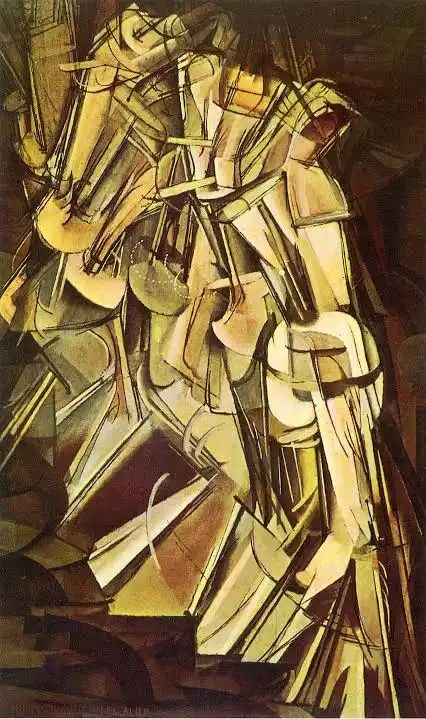
Nude Descending Staircase, No.2 by Marcel Duchamp
By Orion Peyrol
Co-Editor in Chief
Time beats a drum heard by all: the blood rushing in your ears, your back hurting a little more each year, and your breath getting a little harder to catch (that fickle thing runs away a little faster everyday). The passing of time is a heavy weight that hangs over all of us and yet we are subjugated to it: using it to mark our lives, our memories and shape our senses of self. Really, I’d argue that memory is who we are— snapshots stitched together into a multicolored coat we put on and call identity. But our coats aren’t all made the same, and time isn’t as universal as one might think.
Personal identity is difficult to truly pinpoint, we tend to use our nationalities or ethnic identities as signalers to explain why we view or do things a certain way. But that’s much too simplistic of a picture and ignores what exactly they view differently. There are different concepts that affect the way we see the world, but the difference in cultural views on time is the one that paints the largest brushstrokes –it’s so variable– and has a much bigger influence on who we are than we might think. So, let’s complicate this picture a bit, shall we?
I’m not the first person to tell you that cultures differ on many different points. The one we’re going to keep coming back to —our background color if you will— is the idea of collectivism versus individualism, which describes how much a society stresses independence and individuality. Collectivism describes a culture that emphasizes the unity of the group and it’s identity, while individualism emphasizes the individual and their selfhood.
There is a tendency to try and separate these two terms into Western and Non-Western, but that isn’t really the most accurate way to portray it. There are many places around the world we describe as collectivist: Latin America, Eastern Europe, Africa, and certain cultures within South Asia. All of these places have their own version of collectivism and it’s important to acknowledge that it isn’t a monolith within a continent or a nation. It’s not even an immutable part of a culture. For example, we tend to say that Eastern Asian countries are collectivist because they emphasize group cohesion and consensus, but research has shown that traditionally collectivist Japan might be slowly shifting towards individualism. A more accurate way of describing it is that Western cultures tend to emphasize a certain type of individualism and independence but are not the only countries that are individualistic.
“The individualism present in Western societies and especially in North America is about placing oneself as being apart from others, in control of their direction and expression.”
Cultures also differ in how they orient themselves within time — what they tend to focus on. A person and a people can be more past, present or future oriented, all of which can be positive or negative. There are six “temporal frames” coined by Philip Zimbardo and John Boyd in their 2008 book The Time Paradox : past negative (an aversive past orientation), past positive (a warm, nostalgic past orientation), present hedonistic (a pleasure focused present orientation), present fatalistic (a hopeless, helpless view of the present), future (a focus on planning and achieving future goals), and future transcendental (an orientation focused on a future after death). These concepts refer to what time frame a culture views as the most important to focus on and in what way. We can see this as being the composition and framing of our painting.
There is a correlation between a culture being individualistic and it being more future oriented, meaning they focus more on planning for the future and the achievement of future goals. This is partially because they tend to believe that they have more control over the future; that the actions of the individual today are the main driving force leading to tomorrow. Comparatively, collectivist cultures tend to be more present oriented. They tend to focus more on concrete events in the here and now, while promoting a mentality of adaptation to the future rather than trying to control it.
Another way we view temporal differences in a culture is by describing whether they measure time by clock time or event time. Clock time is the reliance on the actual clock to divide up a day, so societies like these tend to value scheduling and punctuality. Event time, on the other hand, is when a place relies on the event ending to move on to something else, not really worrying about the clock itself and allowing things to take the time they need. You probably guessed it — the latter is more common in collectivist, present oriented countries, while the former is heavily present in individualistic, industrialized countries that prioritize efficiency, production and succinctness.
These changes in how we view time can most be seen in the way we tell stories, the types of stories we tell and the stories we tell about ourselves. Most Western societies tell stories in a very linear fashion following a beginning, middle, and an end. One action begets another until the ending. The main character is often the driving force of the story and the one the story acts upon. Suspiciously similar to the narrative Western society tells itself: the individual being in charge of their own fate, doing one thing after the other in pursuit of a goal.
“Our version of time gets reflected in our stories or perhaps our view of time is just reflecting the stories we’ve given it to fit into — the only type of painting we’ve ever been shown.”
It’s what we’re used to but it isn’t the only way of telling stories. Indigenous storytelling, for example, has a structure more akin to a spiral, a circle or even a nesting of stories within stories. Often, there isn’t a specific beginning, middle or end; it entirely depends on when the storyteller feels they should start or stop the story. A story is not something individual, even the experience of being told a story is a collective thing. Stories are viewed as something communal that will continue to grow and evolve with the generations. Personal achievements and life milestones are not the end goal rather it’s the evolution of the community and of your family that matters.
Our stories also affect the way we view time spatially. The direction we read affects the way we conceptualize the flowing of time. In places where reading goes from left to right, time is viewed as going from left to right, usually in a straight line. Whereas in places like China, people view time as moving from top to bottom because that’s the way they write. This means that even the way we read and receive information changes our experience of time. For example, the Aymara culture in South America has a proverb saying “knowing is seeing”, and they view the past as being in front of them because it’s something they know and can see, whereas the future is behind them because it’s unknown. The words and sayings we have about time change the way we perceive it.
There isn’t a wrong or right way to view time. The point of this article wasn’t to tell you about a better way of conceptualizing time, rather to remind us that concepts are fluid. Things that seem as rigid and unaffectable as time are actually just things we’ve made up. Especially as students, trying to work towards adult life, it’s easy to feel like we’re being herded and funneled into set paths dictated by society. Let this be your reminder that time isn’t always money, it isn’t actually as quantifiable as we think, and you always have time to start over and make a painting you can be proud of.
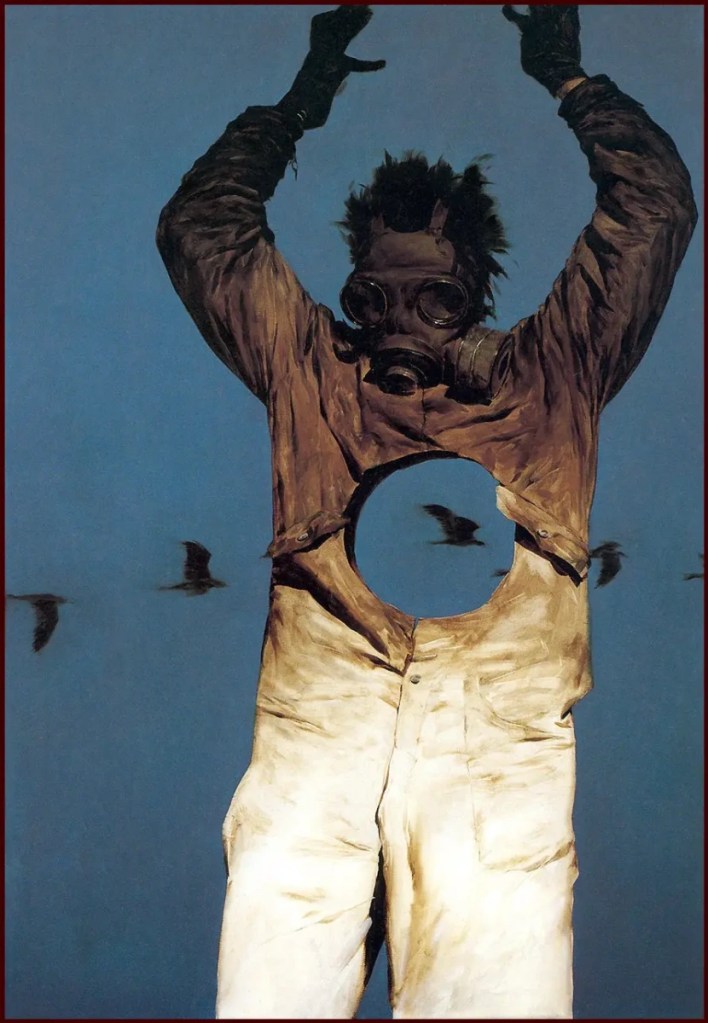
Hole by Phil Hale


Leave a Reply