

Via A24, Tony
As I shifted into the shabby maroon armchair and the theater lights dulled, I couldn’t help but taste the distinct tang of dread on my tongue. The bitterness lingered, slowly slithering down my throat and settling in my stomach, where it seemed to eat away at me. I shut my eyes tightly, desperate for alleviation. But the relief never came. Instead, I was swiftly engulfed by a suffocating sea of smoke.
The stench came first, and second came the man. Perhaps it was fugazi–I thought to myself–a mere dream constructed by fan-like admiration. Regardless of my suspicion, I couldn’t deny it–there he was in all his glory…or lack thereof: Tony Bourdain, roguish in his frayed leather jacket–clear as day on the IMAX 70mm.
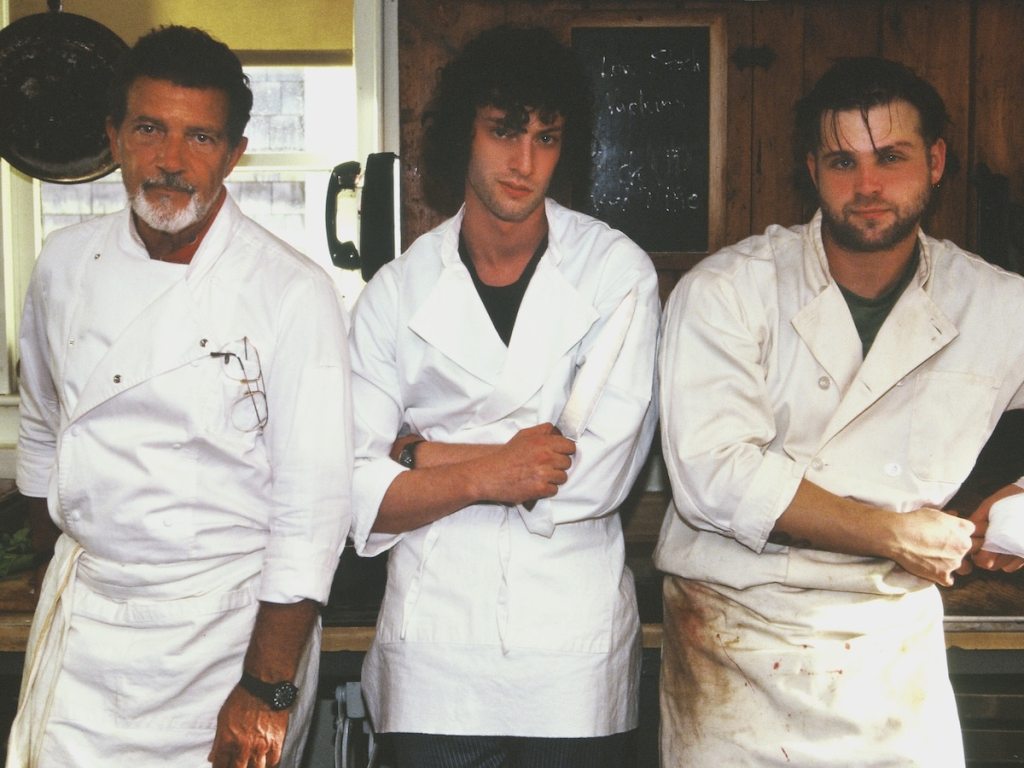
A24’s Tony is a coming of age story, which presents itself as a testament of Anthony Bourdain’s spoiled, miserable, narcissistic, and self-destructive beginnings in Provincetown.
The film undeniably provokes its audience, with Dominic Sessa portraying a deeply unlikeable expression of Bourdain: A perverted, arrogant 19 year-old boy who I never once found myself rooting for. This is a far-cry from the introspective, well-travelled author the world has come to love.
Although entertaining, A24’s cinematic reenactment lifted straight from Kitchen Confidential’s first chapter has brewed a steady unrest in the culinary and arts world alike. Certain critics–myself included–have fostered a sense of familiarity toward the chef–a relationship bloomed from doggy-eared page corners and episodes of No Reservations binged on lonely nights.
With heavy hearts and endless devotion, many have expressed their disdain for the production.
“Tony would’ve hated this…”
fans argue–as if they themselves were ripping marlboros and sipping Stellas with the man. But alas, Bourdain was known for being unpredictable–nuanced in his ways. Moreover, it can be argued that Tony may be a bullet-point lens of the chef’s turbulent escapades, somewhat of a non-comprehensive taste of the 13 books and four series made by and starring Bourdain.
In a world driven by consumerist culture, is this movie, based on a cherished “oeuvre”, a necessity? Shouldn’t we focus on redirecting society back to legacy media rather than repackaging it into content digestible for the masses?
Whilst there may be an undercurrent of truth to these questions–that Anthony Bourdain, notorious free-thinker would abhor the commodification of his cultural footprint–it is well within reasonable doubt that these arguments may be a direct reflection of that which they condemn: A parasocial contempt born from said media.
But the charts don’t lie: Tony stands tall and proud with a 93% Tomatometer score, a testament to the film’s technical prowess despite its growing criticism surrounding its ethical choices. The poignant homage delivers a complex delivery, crowd-pleasing in its conclusion. A saccharine ending of a reformed Anthony Bourdain–with much growing left to do. (I invite any curious person to read chapter two of Kitchen Confidential for a somewhat different suite).
Like many of Bourdain’s self-made works–it is a standard to expect some great, introspective aftertaste of tragedy caressing the narrative. However, Matt Johnson, Tony director, leaves all doom as intimations–an inkling tucked far away in the backs of our minds. We all know how the story ends–there is no happy ending, so why does it taste so sweet?
The story itself is the furthest from honest–with quite little integrity attributed to its validity. Bourdain never survived some extravagant fire–never had to make the heartbreaking choice between the Culinary Institute of America or his high school sweetheart Nancy Putkoski. Any devoted fan is easily able to pick out the myriad inaccuracies used as dramatizing agents. But is that an entirely fair claim to the movie’s worth?
“I’d like to think that [Bourdain] would be watching through the crack of the door, saying, ‘While this is factually incorrect, it is metaphorically true.”
director Matt Johnson expresses in response to fan-pushback.
Johnson’s defense points to the uncomfortable balancing act at the heart of every biopic. The genre asks us to believe we are watching a person’s life while simultaneously giving filmmakers permission to bend it. A two-hour film cannot contain a lifetime without cutting, condensing, and embellishing. Somewhere in that process, fact inevitably gives way to storytelling. The question, then, is not whether a biopic will take liberties, but how many liberties are too many before the person being portrayed becomes a character rather than a person?
But perhaps the problem isn’t simply that biopics fictionalize real people. It’s that we have become increasingly comfortable consuming the lives of real people as stories in the first place. All the nasty, the bad, the addiction, the raunch becomes either inflated to sell to the masses a thrilling, daring tale–or it becomes softened, molded into a digestible version of one’s life. These manipulations of darker truths–the act of placing complex humans on pedestals–is formally referred to by critics as hagiographies.
Via Rolling Stone, Mike Presson
And few worlds have been as susceptible to this kind of mythmaking as the culinary one–especially in modern media. Think of the hit series The Bear as an obvious example. It has become increasingly common to see Chefs being painted as tortured artists or self-destructive visionaries. Their weaknesses turned legendary, almost formative as part of a greater journey. Belittling nicknames and burnt hands transformed into rites of passage.
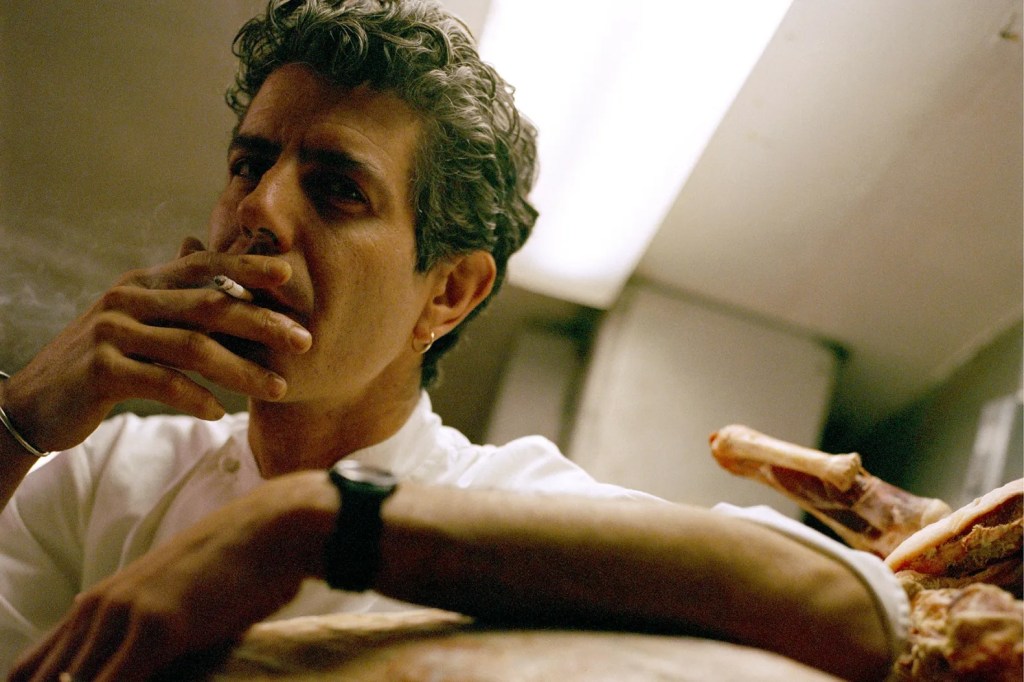
Bourdain, perhaps more than anyone, occupies this mythology. His drug use, profanity, cynicism, and self-destructive tendencies were never entirely separate from his appeal. They were part of the persona that made him so compelling. His chain-smoking habit and melancholic poems became a commodification, a brand.
And that is exactly what makes portraying Bourdain such a tricky task. To buff those darker elements would betray the very qualities that made him Bourdain, but to exaggerate them risks turning a complicated man into another romanticized caricature. The film is thus caught between two equally tempting distortions: making Bourdain more heroic than he was, or making his demons more dramatic than they ever needed to be.
So let us reflect: what is Tony actually guilty of? Some may resent Johnson’s film for reducing Bourdain to a character while forgetting that Anthony Bourdain was, to some degree, a self made character. The chef published his own books, appeared on his own shows, and carefully curated the irreverent, chain-smoking, hard-drinking persona that became synonymous with his name. We forget, he wasn’t our friend. He was a celebrity whose intimacy with his audience was in part, the product he sold. But, Bourdain chose what parts of himself to put into Kitchen Confidential. He chose what stories to tell. He chose what persona to perform on television. Tony makes choices on his behalf after his death.
Maybe that is why the film’s sweetness lingers so uneasily. Tony gives us the redemption we know Bourdain’s real story could never provide. It packages the ugly years into a neat coming-of-age arc, gives us a boy who has not yet become the man we remember, and allows us the comfort of believing that somewhere ahead of him, everything will turn out alright. It is a beautiful lie.
Maybe the fairest way to watch Tony is to extend that same skepticism to the film itself. It is not Bourdain. It is not a definitive portrait. It is another interpretation of a man who has already been interpreted a thousand times.
Still, as the credits rolled in the dark theater, I couldn’t shake that lingering sweetness. Maybe Johnson was right, maybe the film is factually incorrect but metaphorically true.
Or, just maybe, that distinction is exactly what makes Tony so difficult to swallow. We have taken a complicated, contradictory human being and turned him into a story once again.
The lights came back on. The smoke had disappeared. But the taste remained.


Leave a Reply