

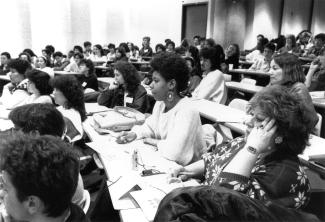
March 11-12 1989. Assembly of immigrant women (Photo by Norman Rajotte)
Via Le Collectif des femmes immigrantes du Québec
By Alaa Ettaouth
Voices Editor
Since the launch of the provincial election campaign last month, I have been frantically following every new announcement and press conference alike. As one of 325 000 new voters this year, I was so excited to do my part and to contribute to our democracy. However, my enthusiasm was unfortunately cut short. Perhaps naively, I expected to come across healthy debates about the many subjects that touch our society: the cost of living, the environment, or how we can preserve our educational system.
Instead, the same incessant rhetoric was thrown in my face. The same anti-immigration script repeated by far-right politicians in France and the United States seems to have threaded its way into our own media and daily debates and is employed by politicians who are meant to represent their people.
But which people? For some, you are Québécois. You were born here, and you screamed at the top of your lungs on Place Bell last spring when the Montréal Habs finally made it to the Series. While your name may not be Catherine or Tremblay, you are still part of the “nous autres” collective, a multicultural mosaic all united by their participation in Québecois culture. For others, you still carry the weight of your parents’ immigrant status, as an “immigrant de deuxième/troisième génération.” You can never really own your Québécois identity. I was born here, speak French, even use Québécois expressions, and sat my whole life on the school benches of Quebec institutions, and I still feel like I will inevitably be crushed by the weight of having to perform this identity to be able to truly call it my own — to be recognized as Québécois.
Gradually, you leave your mother tongue at home, only for the ears of your immigrant parents. You leave your real name at home, simplifying the pronunciation so as not to irk ears that are too sensitive to difference. In all of my years of schooling, I have yet to hear my name the way my mom or dad says it, the way that truly makes me feel at home, because I had accepted that these conversations about differences were never straightforward. Someone was always bound to concede, to conceal a part of themself to avoid the discomfort of questions around identity and belonging.
You simultaneously endure two cultural uprootings: the same one your parents went through, and another that violently strips you of the persona you have carefully crafted and molded yourself into.
When you turn on the TV or scroll on social media, everything leads you to believe that the same persona you thought would undeniably make you one of them is merely a hollow facade. You will always bear the burden of not being a “Québécois de souche.” The label of a foreigner plastered on your forehead obliterates everything else that constitutes your being. Despite your attempts to hide behind the shield of imitation, the traits of your face, the texture of your hair, and the color of your skin scream the story of those who walked here before you, of those who certainly do not belong.
Recently, Paul Saint-Pierre Plamondon, Parti Québécois’ current leader, held a press conference where he declared that the schools are overflowing because of the “excessive” number of immigrants Quebec let into its territory. For him, Quebec’s “capacité d’acceuil” has been saturated for years and therefore, each newcomer’s child should carry the responsibility of an already fractured school system. But what he failed to recognize is that our educational system is actually victim to an “absence of medium-term planning” and not to kids exercising their inalienable right to education. According to Bifan Sun’s article in the media outlet Pivot, following a mid-2000s baby boom, the Montreal School Board was already facing a shortage of space within its territory. During the early 2010s, it urged the Ministry of Education to invest more in school expansion and construction projects, deeming the investment levels at the time insufficient to meet long-term needs.
I cannot help but notice that this phenomenon is not isolated. Rather, it is a symptom of a larger problem at hand: the easily taken route of scapegoating immigrants, especially immigrants who do not have the ability to hide their affiliation to another culture. The immigrant that looks like me is rarely valued for his humanity. He either serves as a political tool to justify social problems or, if given an ounce of consideration, is only valued for his capitalist benefit. We love the good immigrants, the ones who quit their homes to come here and do the jobs nobody wants to do.
“We love the immigrants who stay silent and endure, because that way, we do not have to come face to face with our detached sense of humanity.”
They serve a purpose in our economy, therefore they probably feel fulfilled, as if the entirety of the human experience should be reduced to what they bring to a capitalist system that values egocentric desires more than the connecting human struggle.
Even as I am writing those words, I find myself filled with the impression that I need to justify my existence. To be able to criticize the order established, I must first proclaim my gratitude to a place I wrongfully assumed I belonged to and attempt to repress the hurt created by my identity being called in question.
Immigrants and children of immigrants deserve more than to be stripped of their human dignity and reduced to the tears and sweat of their labor. They deserve to belong to a place and to rightfully call it home without having to debate their dignity.
So, before casting your vote in this upcoming election, let this be a critical reminder that the dehumanisation of some might just mean the degradation of the rights and freedoms of all.


Leave a Reply