

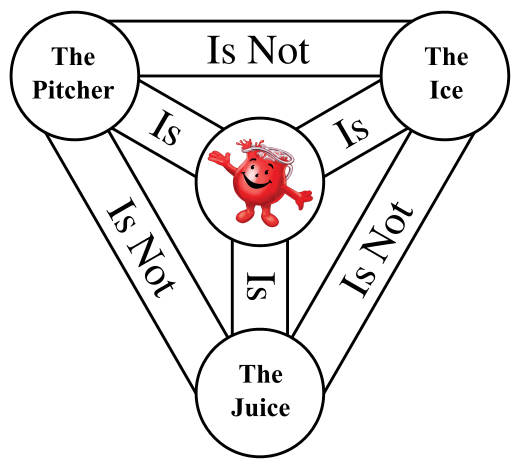
Via https://omnism.church/non-duality/
Raul Romero
Contributor
This summer, I was extremely fortunate to have been given a copy of the Ethics by Benedict “Baruch” de Spinoza by my lovely partner. It’s a five-part philosophical text aiming to, among other things, encourage living a “rational” life of knowledge and reason. What’s not to love? I’ve always been interested in these sorts of documents, even if I don’t entirely understand them at times. He shares his beliefs with fellow pre- Enlightenment era intellectuals such as René Descartes and Thomas Hobbes, but where he differs from these other thinkers is in his belief on the nature of God.
To explain (not so) briefly what took pages to explain: Spinoza claims that all objects and beings derive from one infinite substance, the Abrahamic God. All other finite substances are but attributes, or modes, of this infinite substance. Because something that is finite cannot sustain itself, an infinite source of an infinite number of attributes and modes must necessarily exist; and whatever is said to “necessarily” exist means that it is their nature to exist. Therefore, God exists because it is in its (we’ll get back to this later) very nature to exist.
The world exists because it is its nature to exist; and since we necessarily exist, it is necessarily within God’s nature to make us exist. Because we feed from its infinite wellspring, we contain bits of God’s essence (parts of its attributes and modes), which is also in our nature to have.
Are you following? No? That’s okay! Neither was I. Scholars still debate over whatever Spinoza really meant. He was a real weirdo. That’s probably why he was kicked out by the Sephardic community back home in Amsterdam, but that’s just a hunch.
This isn’t exactly what I wanted to talk about today, though. Recently, in one of my classes, the topic of Hinduist belief and tradition came up–more specifically that of the Advaita Vedanta school. Here, I learned about the concept of Brahman, the “ultimate reality”, as per Jim Greene in his EBSCO article. Brahman has no singular correct interpretation; it is the supreme god, the truest reality, the beginning and the End.
Within the Advaita Vedanta school of philosophy, Brahman is commonly thought of as the universe, or rather the forces behind it. According to Sangeetha Menon of the National Institute of Advanced Studies in an article on the Internet Encyclopedia of Philosophy, the word “Advaita” translates to “non dualism”, meaning that there is no “one” or “other”. All is one with each other and with the Brahman whereas, according to Menon, the concept of plurality is a result of the ignorance towards the true reality, Brahman.
Now, these are very large oversimplifications of two very distinct and very complex beliefs, and they shouldn’t be mistaken, these tiny close-up shots, as the whole image. You unfortunately lose some details when attempting to be concise. What I found interesting, though, were the many parallels between both systems of thought–the most obvious parallel being that the divine godhead encompasses the universe and its inhabitants. Spinoza’s God (I told you we’d get back to this) differs from the Bible’s God. He prescribes the name “God or Nature” to it. The word “or” here is the Latin “sive”, which denotes equivalence. God, for Spinoza, is not an entity; it’s the gravity that pulls quarks together, that create the protons and the neutrons, that create the periodic elements, and so on and so forth.
Advaita Vedanta suggests that everything is one with the Brahman, that it is within all. This similarity slowly fades out starting from here, as the Advaita tells us we are all siblings. Meanwhile, Spinoza prefers baptizing everything as cousins with varying levels of familial affiliation.
The last parallel is that of the attributes and modes of God and the Trimurti, the three Hindu deities. This triad consists of Brahma, Vishnu, and Shiva. They all represent different aspects of life (creation, preservation, and destruction, respectively). Greene states that this trio, alongside various other associated deities, are considered expressions or manifestations of Brahman. In a similar way, every substance derived from the infinity of God, according to Spinoza, contains an attribute of it. These attributes can come in different manifestations, which he calls modes.
The correlation I’m making here is that both have expressions of the divine outside of itself. Where one is in characters, the other is in qualities. That’s what I love about learning – being able to interpret and compare ideas and, hopefully, understand them a little more. I’m sure I have… I think? Maybe I’ll get further in the book and I’ll be proven entirely wrong. Who knows! That’s the joy of philosophy, baby!


Leave a Reply