

Via Charlie Reuter
By Charlie Reuter
Science & Environment Editor
Allow me to show you a problem. It’s not a hard one; you know all the math required since Secondary III. Solving the math is not the point, though. What makes it my favourite problem is the fun one has trying to visualize the completely counterintuitive solution. Are you ready? Let’s go.
Picture a 4-by-4 square. We’re starting with two dimensions for now. Inside your mental square, place 4 circles of radius 1. These are our packing circles. They should fit nicely and touch all the edges — but there’s still a space left in the middle. Imagine placing a circle in that space. Now here’s the question: what is the radius of that smaller circle?
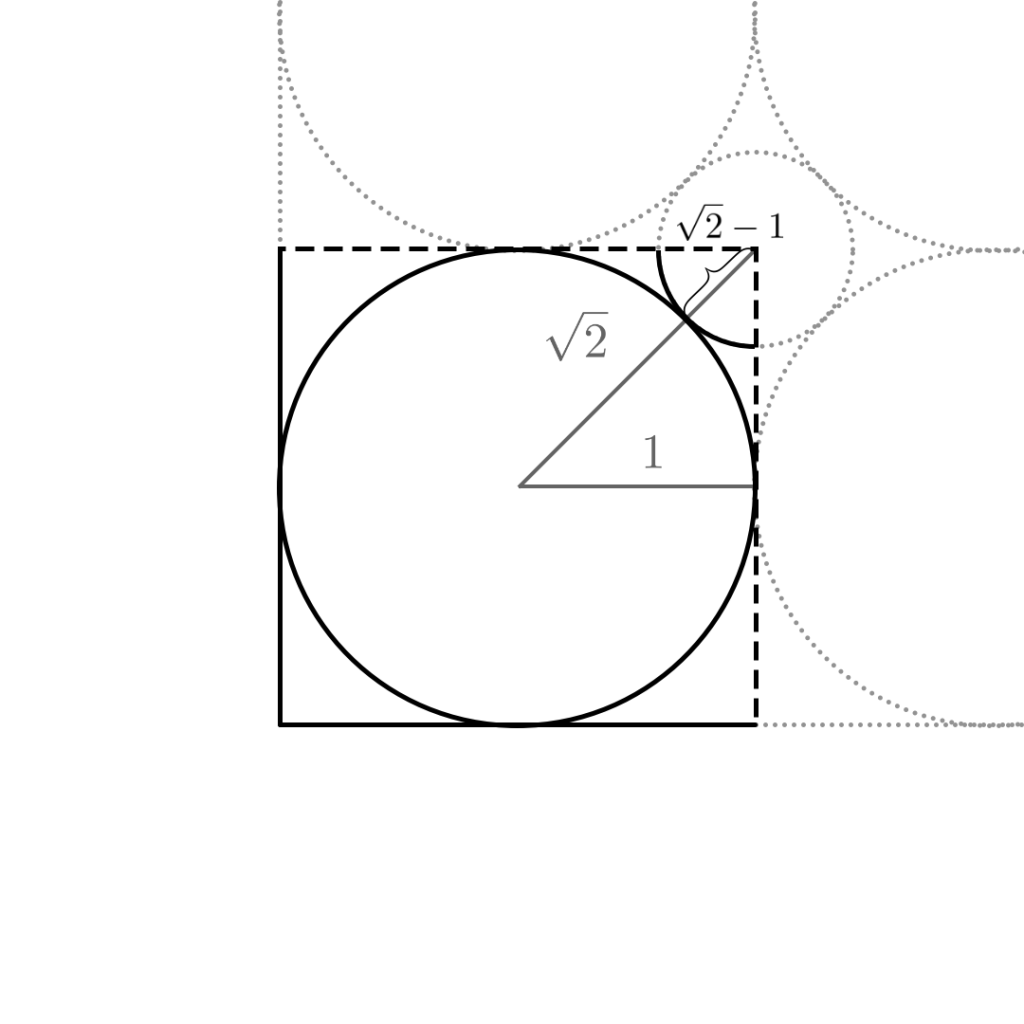
Let’s look at only one quarter of the square, to simplify things. You now have a 2-by-2 square with one circle touching all sides, and a quarter circle in the corner, as shown in the figure below. Using the Pythagorean theorem, you can find the diagonal of the square, which is =. Now divide that in half, and you get the distance from the center of the packing circle to the center of the smaller circle, . But wait, we already know the radius of the packing circle — it is 1! This means that the radius of the smaller circle is ≈ 0.41.
“Okay,” you say. “That doesn’t seem too surprising.” Well, then let’s take it one dimension higher.
In 3D, we now have a 4-by-4-by-4 cube, with 8 packing spheres of radius 1, and a smaller sphere in the middle, as shown in the figure on the right. Did you know that the Pythagorean theorem works for higher dimensions as well? In 3D, the formula for the length of the hypotenuse is . We can use the same method that we used in 2D to find the radius of the center sphere, by taking the diagonal of an eighth of the cube, dividing it in half, and subtracting 1:
This simplifies to ≈ 0.73. Why, now, the object in the middle which was first a circle and now is a sphere has grown bigger!
It turns out, if you upscale the problem from 2D to 3D, you can fit a larger sphere in the center.
One step further, in the mysterious fourth dimension, the radius of the center (hyper-) sphere will be , the same size of the packing spheres (I will call them all spheres from this point on, regardless of their dimension).
In fact, one can generalize this relation: the radius in the nth dimension is .
In 5D, the radius is
In 9D, the radius is 2 – the sphere is touching (the correct math term is “kissing”) the sides of the box.
In 10D, the radius is ≈. This means the center sphere now has a diameter of 4.32, while the box is only 4 wide — it has escaped the box, despite the 1024 packing spheres trying to contain it.
Huh.
This is a classic paradox; it has been around at least since the 1960s, when Martin Gardner mentioned it, referencing an unpublished problem by Leo Moser. It is often used to demonstrate the counterintuitiveness of higher dimensions.
The conundrum doesn’t stop there, either. There are those who say that higher-dimensional spheres are “spiky,” extending their spikes beyond the box, while others argue it is the box which becomes “spiky.” Math educator Grant Sanderson (known as 3Blue1Brown) recently gave a great talk entitled “The Most Beautiful Formula Not Enough People Understand.” If this puzzle interests you, I recommend checking it out! And I hope you have fun twisting your brain further into a pretzel.


Leave a Reply