

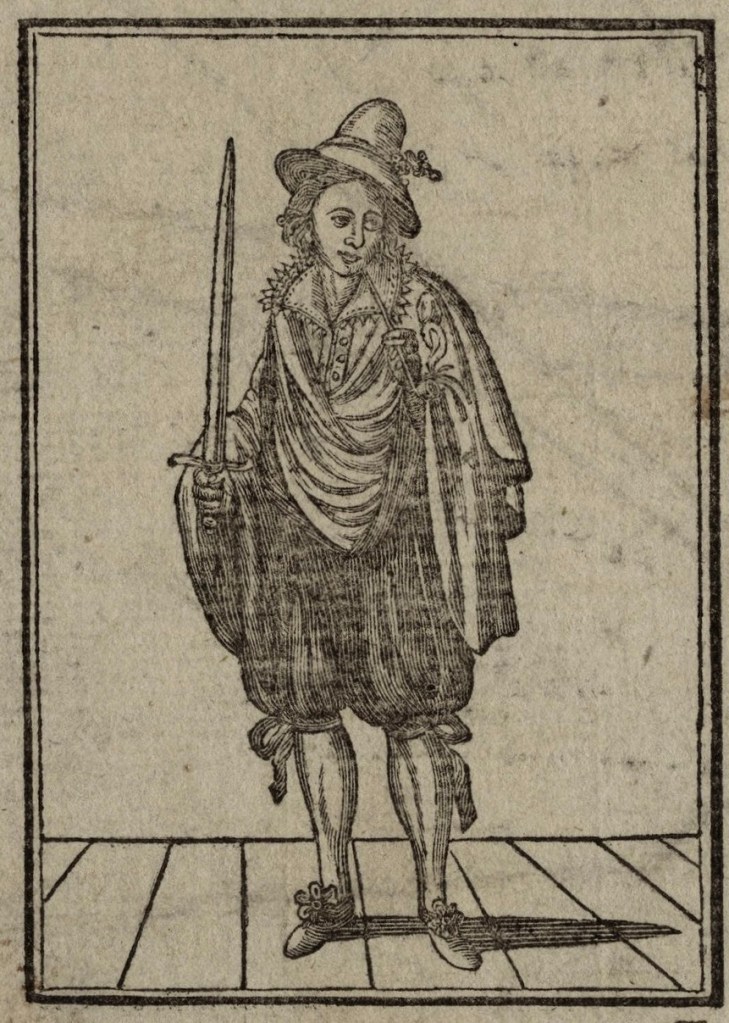
Via Pinterest
Simon Jaffary Osowski
Visual Arts Editor
“Today marks ten years since I kissed a very attractive twink in a club in Brighton and then found out she was a lesbian who thought I was a lesbian,” mused X user Ryan Burgess in a 2018 tweet. We tend to think that this type of confusion of gender roles in romantic or sexual relationships is a brand-new invention of the twenty-first century, but upon the examination of the British popular ballad, the opposite seems true: people have been fascinated with this same phenomenon for centuries. What about these songs reminds us of the present day? More interestingly, how are they not at all the same?
One very renowned marine ballad of Irish origin, dating from at least the eighteenth century and known variably as The Rakish Female Sailor, Short Jacket and White Trousers, and A Maid That’s Deep in Love, recounts the tale of a woman set on reuniting with her love in the Americas by dressing up as a young sailor boy to board a ship heading across the Atlantic Ocean. While on board, the sea captain makes a move on her, all while thinking, of course, that she is some attractive young lad: “Your rosy cheeks and ruby lips they are enticing me / And I wish to God with all my heart, a maid you were to me.” The eyebrow-raising description of the captain’s advances has implicit gay undertones, all while maintaining plausible deniability of the situation, since it is technically a heterosexual attraction.
In passing, it is also interesting to note that, according to the National Maritime Museum, women’s cross-dressing to join the navy or the army in the British Isles during the seventeenth and eighteenth centuries was not at all uncommon, and there are multiple examples of sailors and soldiers revealed to be women.
A jolly English ditty by the name of The Merchant’s Son and the Beggar Wench from the seventeenth century or earlier, tells the story of a wealthy young man who gets “rolling fu’” (intoxicated) with a beggar woman at a drinking house. The two have a one-night stand, and, in the early morning hour, the beggar woman rises, puts on all the merchant’s clothes, and is proudly on her way. The merchant, waking, has no choice but to shamefully put on her “ragged petticoat and […] linsey gown” and angrily leave the inn. One wonders at the interesting conception of masculinity as a thing to be coveted, and as a thing which can be stolen away by a woman of “low degree.”
The Jolly Tinker, an old Irish song, features an exchange of gender roles in a more subtle manner. ‘Tinkers’ (known now as Irish Travellers) were a nomadic people in Ireland who brought tinsmithing services from cottage to cottage, and this tale recounts the story of one lady of the house who was in the market for a bit more than frying pan repair services. After bringing the man to her chambers and having her way with him, “She put her hand into her pocket and she pulled out fifty pound, / Sayin,’ “Take this, me jolly tinker, and we’ll have another round”. This is of course an intriguing reversal of the typical configuration of prostitution.
Ballads of the British Isles come in many forms: innocent and sweet, blithe and bonny as nursery rhymes, sprawling and bloody and full of haunting and murder, or, as we have seen, teeming with the same explorations of gender that echo present-day feelings on the topic. The thing all these ballads have in common, though, is their narrative form: they are more focused on spinning a story than a single person’s expression, and the tie between singer and text is far looser. According to the academic researcher Lucie Duggan, in British folk tradition, a male singer might sing from the point of view of a female character, and a female singer might sing from the point of view of a male character.
The emphasis on narrative takes up more space in these songs than what might otherwise be allotted to a furthering of personal identity. Perhaps the storytelling nature of these songs paints gender in all its variations as a thing more situational and less closely related to personal identity. What’s important in A Maid That’s Deep in Love, for instance, is not the personal identity of the heroine, the way gender expression is tied up in today. It is rather her situation, the description of her story, which shapes her unusual gender expression.
Strong narrative structure and the use of third-person perspectives is the standard of Western music no longer. Perhaps this change is indicative of a larger shift in gender ideology; one which is more focused on personal identity, and in the process, sheds the idea of a gender understood through storytelling.


Leave a Reply