

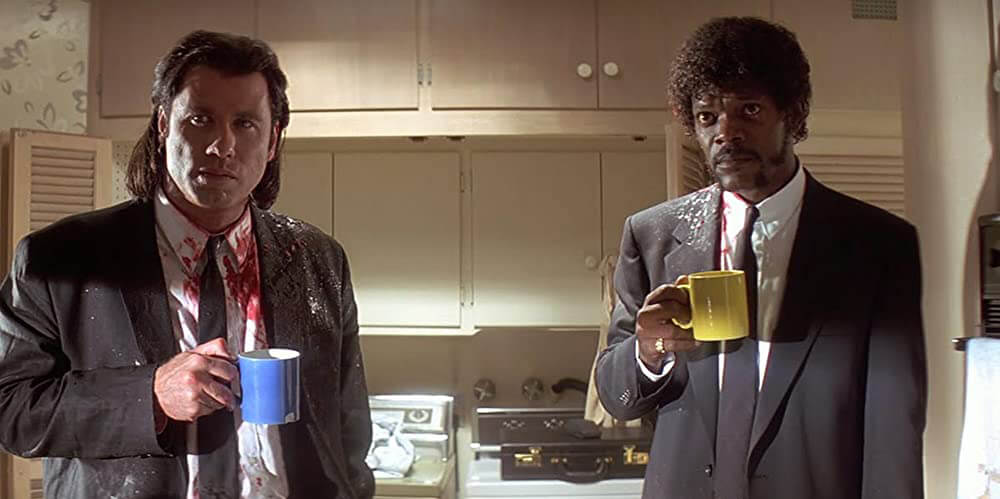
Via Pulp Fiction
Elsie Duque Hills
Co-Managing Editor
I thought I knew it all.
I mean, Pulp Fiction reformed me. Jimmy makes the best coffee — “Some serious gourmet shit.” What other caffeinated truth could possibly be out there?
But, of course, my inner empiricist had questions. And so there I sat, recreating a scene from your mother’s favourite spaghetti western: a staredown between myself and a cup of black coffee. Could I find truth in those velvet-roasted swirls? How had Jimmy made the single, universal, greatest cup of joe out of such a seemingly inconspicuous liquid?
Well, here’s the good news: you don’t actually have to visit Jimmy for a decent cup.
These days, specialty coffeehouses line our streets like stars light the sky. Iced lattes, flat whites, cortados, cold brews, nitro brews. The world’s favourite vice has become more than a morning stimulant and has instead transformed into a multi-faceted experience.
And the plug? Your local barista.
Society’s most artistic dealer might just be Dave, the overworked student microfoaming three-percent milk at six in the morning. The modern barista engages in a precarious waltz, perfecting a careful dance of steady hands and talkative mouths. First, you feel seen. Then, you feel patient. Finally, you feel buzzed.
Steaming milk is rehearsed into choreography and espresso becomes an emblematic hue.
“The barista does not simply make your coffee. No — those days are long gone. The barista now curates the drink.”
Somewhere along our long-winded timeline, coffee became something we no longer consume half-heartedly. It has flourished into something we appreciate, something we yearn to observe. An edible Monet. But who — or what — has framed this artistic perception?
Well, we can start with the unsung hero who sits behind the counter. Interestingly enough, as espresso machines proliferated and became synonymous with daily routine, the role of barista became ever so desired. Diverse regions have tailored coffee brewing in accordance to their respective populations. From the Italian cappuccino to the Spanish café con leche, baristas have consistently added their personal touch to each preparation. Perhaps the most diverse interpretation is the North American demand for artisanal coffee, which has undeniably shaped and transformed the way we consume the beverage.
And now, I implore you to reflect. What have you been ordering lately at Myriade? Chances are most of us have gone quite gourmet with our poison. The coffee industry has undergone a remarkable shift from classic brew to extravagant house syrups. The surfacing of metrics like quality, intricacy, and origin have infiltrated the world that baristas govern. However, do not be fooled. Your local barista is nothing short of a coffee connoisseur. Not only does your pumpkin-spice latte taste unreal, but it looks ever so mesmerizing. Quick — take a picture before enjoying that first sip feeling.
Thus, we can establish a fact: intricate coffee orders are visually appealing. Sure, this may seem rather mundane, but closer inspection reveals an underlying truth about our cultural habits. The digital age has without a doubt intensified the commodification of taste and flavour. From the virality of mukbangs to Hailey Biebers, the trend-setting model behind the now-infamous smoothie, consumption has become a curated experience as well as something to witness firsthand. Naturally, we do not want to just observe indulgence, we want to participate in it as well.
So when your favourite influencer posts a review of the world’s most eccentric cup of coffee, perhaps a coconut-lavender-Earl-Grey concoction that looks more like a chemistry experiment performed by Dr. Frankenstein, it is only natural to feel incentivized. Suddenly, that $8 cup is not just coffee, but rather a transcendental experience, an aesthetic that helps you attain some unachievable cultural cachet. As journalist Michael Pollan put it, capitalism and caffeine go hand in hand.
It may be true that coffee is the modern canvas, but it can also be highlighted that this artistic quality stems from our current consumerist culture. Accentuated by the chase for culinary trends and the romance of a dark mocha latte, coffee has become as much a feast for its observers as it is for the palate. After all, we eat with our eyes first.
In finality, I would not dare reduce Jimmy’s indubitable brewing talent, for baristas are genuine artisans, and there is not a single doubt of it in my mind. Regardless, the way in which consumerism has made coffee’s artistry commercially valuable should not be lost on us.
So go ahead. Order the ube cold foam. Try the lavender matcha. Indulge in the six-dollar cup of coffee that tastes so saccharine it leaves a film in your mouth. There is nothing inherently wrong with enjoying the eccentric. But perhaps, before that first sip, it might be worth asking yourself why you wanted it in the first place — and who exactly has been telling you to crave it.
After all, Jimmy may have made “some serious gourmet shit.” But lately, it seems we have made an entire culture out of it.


Leave a Reply