

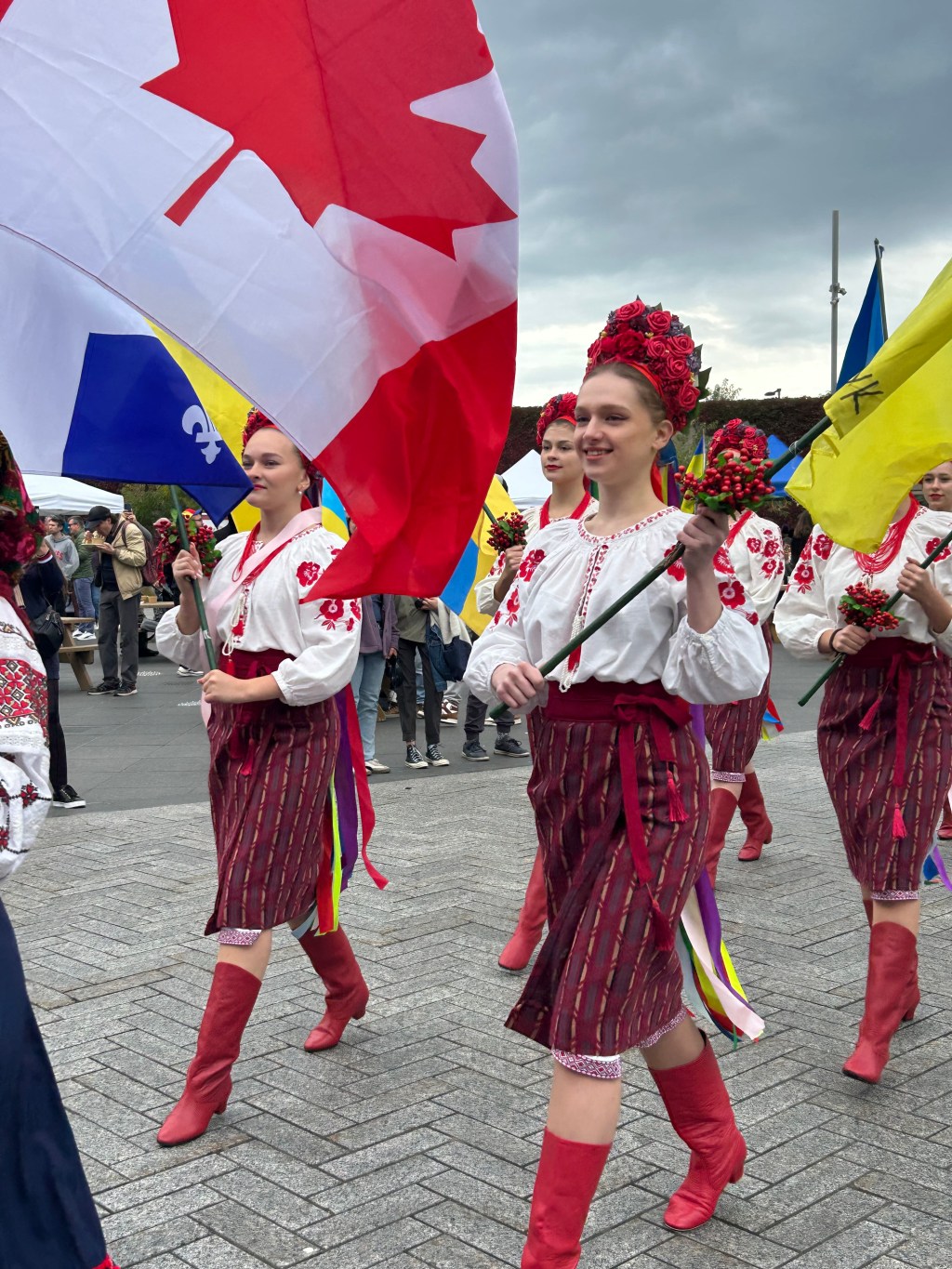
The Korinnia Dance Troupe marching in Square Viger, via Karina Awad-Battista
Karina Awad-Battista
Staff Writer
It is a sunny October afternoon, and I am sitting in Square Viger eating a bowl of warm borsch.
This is what was advertised as the point of the whole event. On their poster, in bold, blue letters: “Free borsch, served to everyone.” In reality, it is so much more. There is a small stage set up in the square where musicians are gathered. A Ukrainian song starts playing, prompting a group of young women in traditional clothing to start marching through the square, holding Canadian and Ukrainian flags. The public space has become a sea of yellow and blue, where even some dogs sport yellow handkerchiefs. Above all, there is a sense of community and pride.
For those of you who are unaware, borsch is a traditional soup dish originating from Ukraine. There are infinite variations, but the most well-known is made with beets and garnished with sour cream, served with some bread rolls on the side. Today, borsch is a staple in many Eastern European households and is seen as an integral part of Ukrainian culture.
Merci Borsch started in Montreal in 2023, not just as a way of sharing Ukrainian culture with the city, but primarily as a way of giving back. It’s organized by the Ukrainian Canadian Congress, who state in their advertisements that the goal is to thank Canadians for being so welcoming to immigrants arriving due to the war. The event is strategically placed close to Thanksgiving to honour the spirit of the holiday. “[The newcomers] didn’t have much to give, but what they can give is their cooking. That’s what it’s all about today: to say thank you to all the Montrealers, all of the Quebecers […] for their hospitality,” said spokesperson Michael Shwec during the event. This is the third edition of Merci Borsch (there was no event in 2023/2024), and it has grown lots in such a short period. Originally exclusive to Montreal, it is now taking place in 5 cities across Quebec: in addition to Montreal, they’ve added Quebec City, Saguenay, Granby, and Sherbrooke. Since it’s completely free, the event relies entirely on community support. This year, volunteers made over 500 liters of borsch, coming out to about 2 000 bowls.
The event is set up in the form of various tents, each with a different kind of borsch to try. There were a total of 5 varieties offered, each with their own particularities: classic, with eggplant, with cranberries, etc. Throughout the event, the chefs from the tents each took turns presenting what made their borsch special and how exactly they came up with the recipe. Some were independent chefs, while others were from restaurants: Perogie Lili, a Ukrainian restaurant in the Mile End known for their varenyky, had their own variety of borsch offered. Another booth offering the classic borsch was manned by I’mmigrant, a non-profit that offers support for immigrants throughout Quebec. Each bowl that was served came with the option of sour cream, garlic bread, and various other snacks. The choice of dish served is anything but random; borsch has become a symbol of hospitality over the years for several reasons. It’s cooked in large quantities, easy to make, and can be cooked with ingredients that are usually already on hand. It has become so important in Ukrainian culture that UNESCO has even declared it a piece of “Intangible Heritage”. In short, it represents everything that the event holds at its core.
Although the premise is focused on food, the event is certainly not lacking in entertainement. One of the tents was set up by the Ukrainian Library in Outremont, with a table of various Ukrainian books and upcoming community events. The building that houses it, which will soon be undergoing renovations, is full of books about Ukrainian history and culture, both in Ukrainian and in English. The aforementioned performance with the flags was done by the Korinnia Dance Troupe, who performed an elaborate dance to open the occasion. One of the most impressive parts of the event was a fashion show focused on traditional clothing. A group of around 30 people came on stage in a variety of outfits, each presenting the purpose of the garments. Some were meant to be used during certain events, while others came from specific regions of the country. Most included intricate embroidery and, above all, they were all clearly priceless. Despite some of them being quite old, they all seemed to have been very carefully preserved by the independent collector that owns them.
Merci Borsch is an event that is focused on so much more than just celebrating Ukrainian culture — actively including others in it. The purpose is to bring everyone, no matter the culture, into one space to try new foods and explore the beauty of Ukraine’s culture. It is rare these days to find events that are both affordable and fun, but Merci Borsch has managed to do just that. It’s an excellent place for anyone, Ukrainian or not, to find a sense of community, make new friends, and eat a warm bowl of borsch.


Leave a Reply