

Via The Washington Post
By Alexander Lopez Ricaurte
Contributor
Generation Z is often labelled lazy, spoiled, and constantly complaining about the circumstances of the world we live in. We are told to simply accept an economy that does not provide for the working majority, yet we are blamed for being unable to afford a house or let alone the basic necessities needed to live comfortably. Instead we are told that we should “pull ourselves up by our bootstraps” and just “work harder”. But the truth is that we are living through a major transitional period in history marked by economic uncertainty, wealth inequality, exploitative monopolies, and a growing sense of awareness that things need to change for the better. We were born in a world that was already starting to crumble as governments began to prioritize profit over people in the late 1970s. Now, we are left with the responsibility to help address these issues so that the next generation can live in the world that we envisioned. Although the idea that Gen Z has inherited a world facing social instability may seem negative and unfortunate on our part, we should see it as hopeful and encouraging that the future of our society isn’t completely doomed, but rather just changing.
As Mark Twain’s novel The Gilded Age: A Tale of To-Day suggests:
“history does not go in circles, but instead spirals.”
The historical era most similar to our own is the Gilded Age, which lasted from the 1870s to the early 1900s. This era marked a time of major technological expansion, much like the times we are living in now. The overwhelming growth in railroad construction and steel production of those times mimic the rise of A.I and modern computers in today’s age. Although both periods show a rapidly growing economy and further technological advancements, beneath this progress reveals a society that allows corporations to prioritize profits over workers’ wellbeing to further accumulate wealth at unprecedented rates. This parallel suggests that history has not repeated itself but instead spiralled back to familiar problems from more than a century ago. The Gilded Age may have not been driven by the rise of A.I and modern technology, but the underlying struggles between corporate power and wealth inequality are remarkably similar.
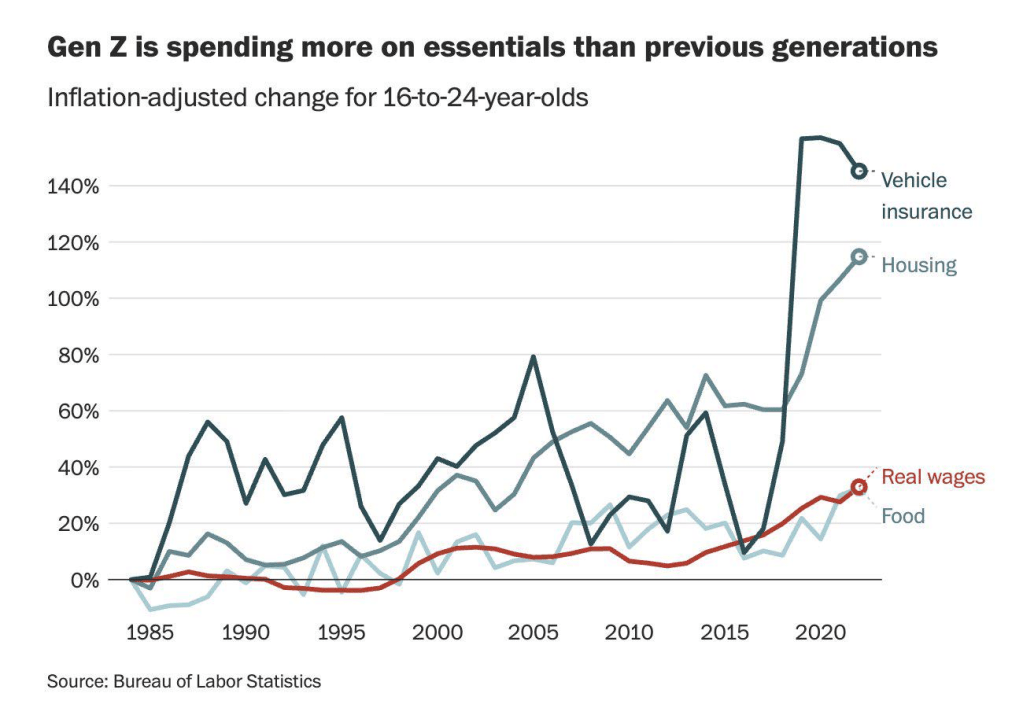
Thomas Piketty’s chart Figure I.1. Income inequality in the United States, 1910-2010, highlights the similarities between the economic issues of the Gilded Age and today’s world. Income inequality in the U.S. was at its highest during the early 20th century before drastically declining by the early 1950s. However, inequality began rising again in the late 1970s, with the income inequality rate rising to 45% by the 2000s. This increasing surge in income inequality mirrors the economic divide seen during the Gilded Age, suggesting that many of the same economic problems have resurfaced in today’s world. In addition to this growing income inequality, things aren’t getting any cheaper either. The basic commodities that make up our everyday lives are becoming increasingly more expensive. A Washington Post analysis of the Bureau of Labor Statistics found that people from the ages of 14 to 24 years old are spending more on essentials such as food and housing than previous generations. These issues have developed a growing frustration among younger generations, leading many to question the point of working hard if it doesn’t even guarantee financial security.
Although Gen Z has become one of the generations most affected by wealth inequality, it doesn’t necessarily mean that nothing is being done to change it. Instead, living through the consequences of economic instability has actually encouraged young people to become more politically involved. Rather than just accepting the system as it is, Gen Z has shown resistance towards these institutions primarily through online activism on social media. The internet has provided young people the ability to bring awareness and support towards social issues that may not be covered by major news outlets. There are already signs of Gen Z’s influence on the political landscape, with democratic-socialist candidates like NYC Mayor Zohran Mamdani gaining support from a predominantly young voter-base after advocating for better working conditions.
Across North America, Generation Z may not be leading a revolution in a traditional sense. We’re not overthrowing governments or completely rebuilding our society, instead we are internally questioning our institutions and advocating for change through what we share on social media. Perhaps our generation isn’t just “lazy” or “unmotivated,” but rather we are simply refusing to accept a broken system that doesn’t provide for our society as a whole. If we continue to resist, our world may just change for the better.


Leave a Reply