

Via Charlie Reuter
Charlie Reuter
Science & Environment Editor
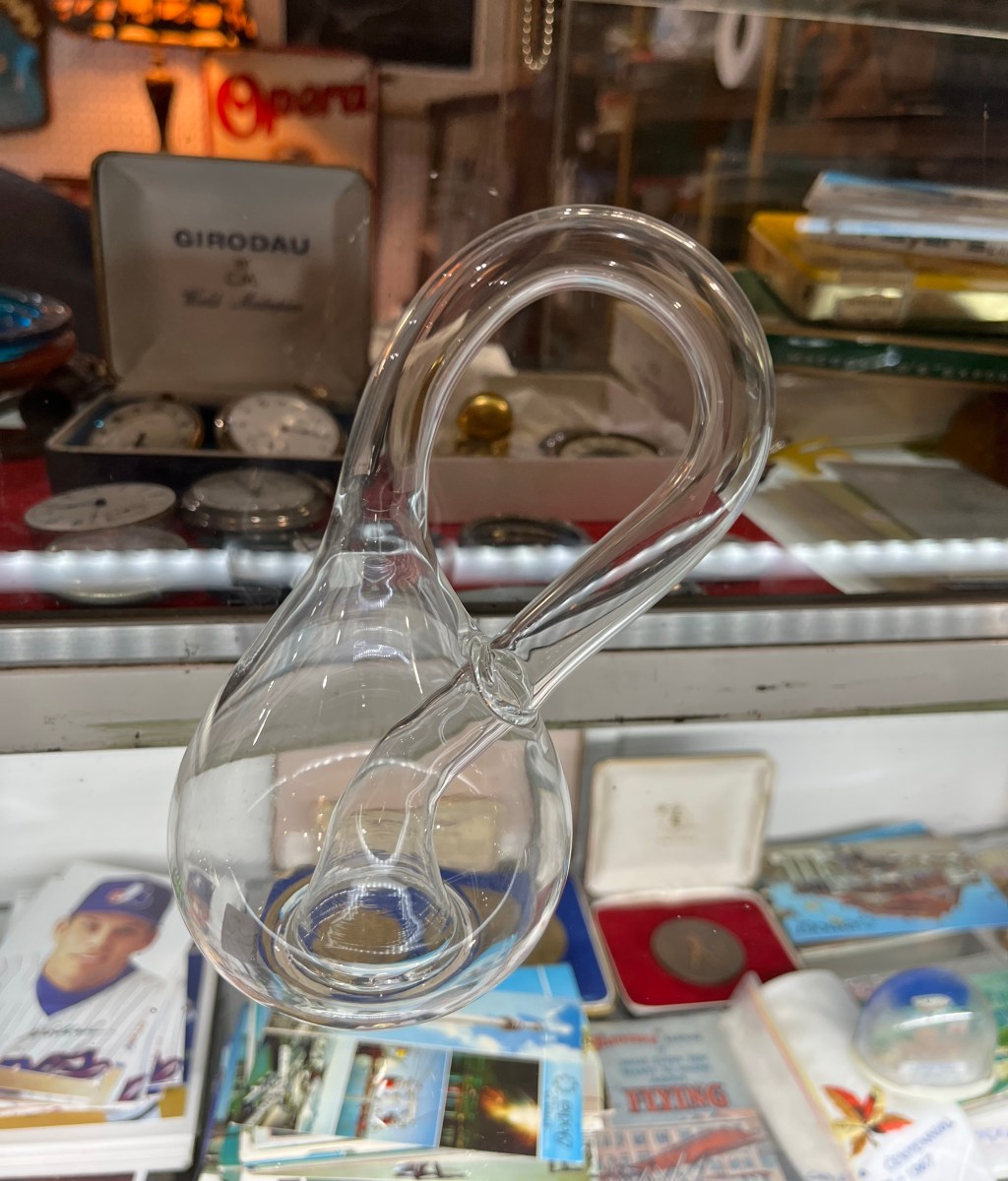
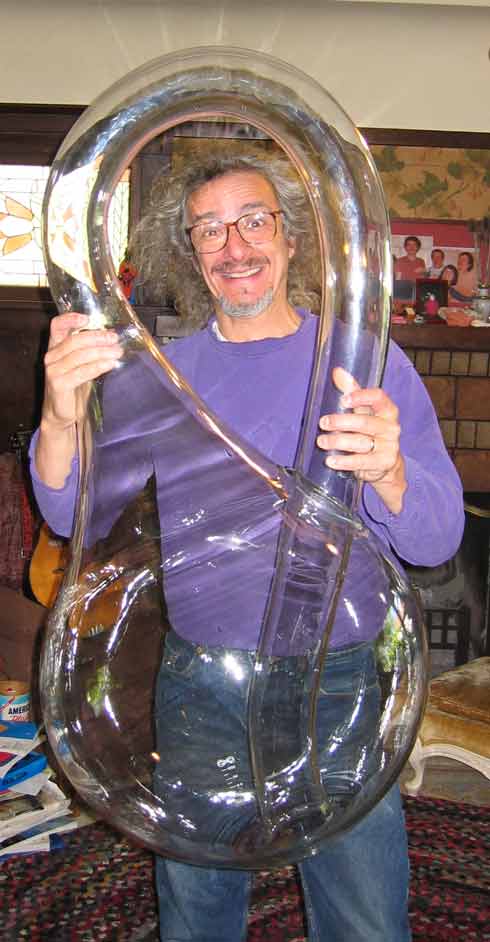
Can you believe what I found at the St. Michel flea market this summer? A Klein bottle!
You might have figured from last month’s math column that I am a big fan of the higher dimensions. The Klein bottle is just my cup of tea. In fact, this weird, loopy, twisty thing is the 3D shadow of a shape that exists in four dimensions.
Named after mathematician Felix Klein (1849 – 1925), the bottle has some very interesting topological properties. For one thing, despite being called a “bottle”, it has zero volume; it does not divide the universe into an “inside” and an “outside”. To understand why this seemingly arbitrary shape is of interest to mathematicians, let’s go do some mental origami.
Picture a strip of paper (represented by rectangle #1 in the diagram). Now, imagine gluing the left side to the right side so that the two arrows line up and point in the same direction. The shape you get is a hollow cylinder.
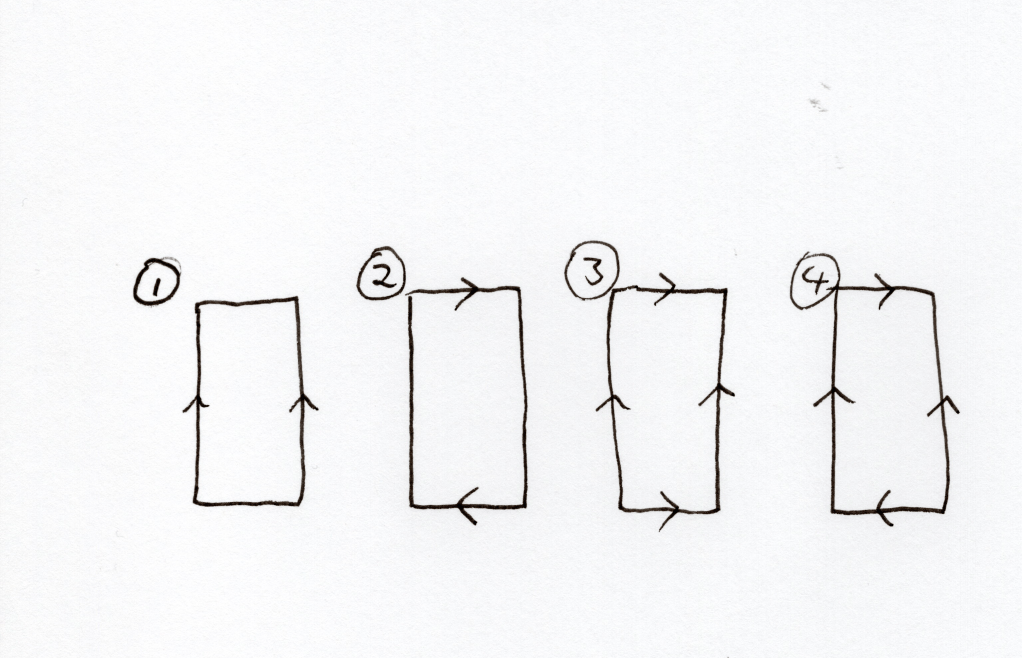
Next, take a look at rectangle #2. Notice that the two arrows point in different directions. This means we need to twist the paper once before gluing the two (short) sides. You might have heard of this shape before: the Möbius strip.
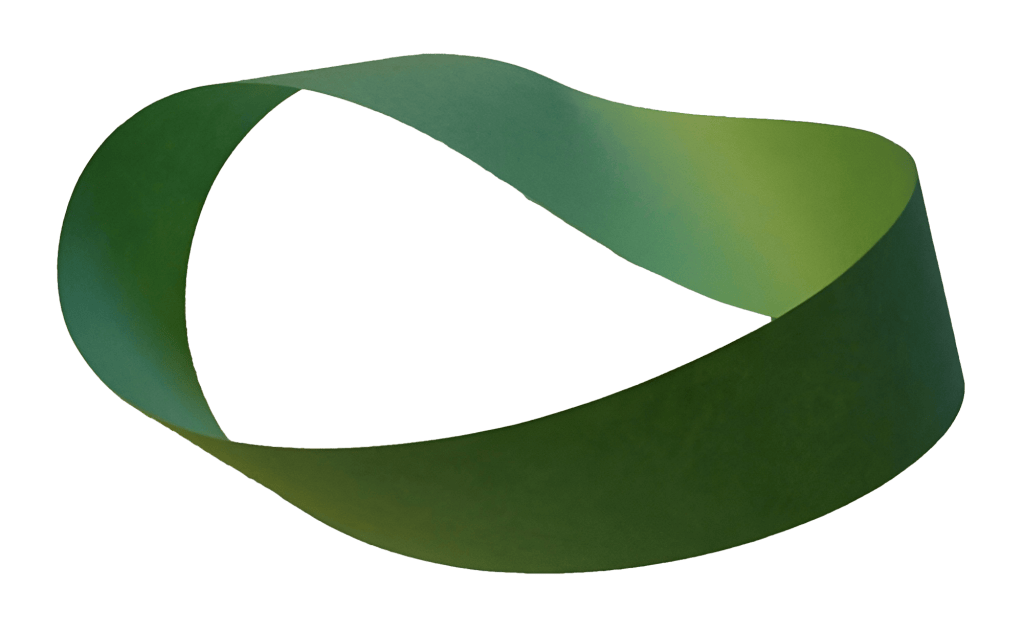
This shape is related to the Klein bottle, and shares some of its interesting properties. It is non-orientable: for example, if an ant were to walk along a Möbius strip, it would soon find itself back where it started – but on the other side and upside down. A Möbius strip has a single surface and a single edge.
Mathematicians spend their time asking extraordinary questions, for example: if a Möbius strip has only one edge, what shape would one get if one (theoretically – you’d need to be 4 dimensional to actually do this) glued the edges of two such strips together?
A mathematician named Klein
Thought the Möbius band was divine.
Said he: “If you glue
The edges of two,
You’ll get a weird bottle like mine.
Limerick by mathematician Leo Moser
In rectangle #3, the pair of short arrows and the pair of long arrows need to be glued together, each pair pointing in the same direction. The result should be a donut (a “torus”).
What happens now if the short arrows (as in the Möbius strip) point in opposite directions (see rectangle #4)? This means we have to somehow glue one edge of the tube to the other from the inside. The only way to do that is to pass one end of the tube through itself. The resulting shape is a Klein bottle. (Try using your hands to figure this out – both tips of your index fingers are the arrowheads and touch your thumbs, the arrow tails.)
Sadly, the true Klein bottle only exists in the 4th dimension, where it does not intersect itself. The shape I bought in St. Michel is a Klein bottle that is “flattened” with respect to the 4th dimension – a “shadow”, if you will.
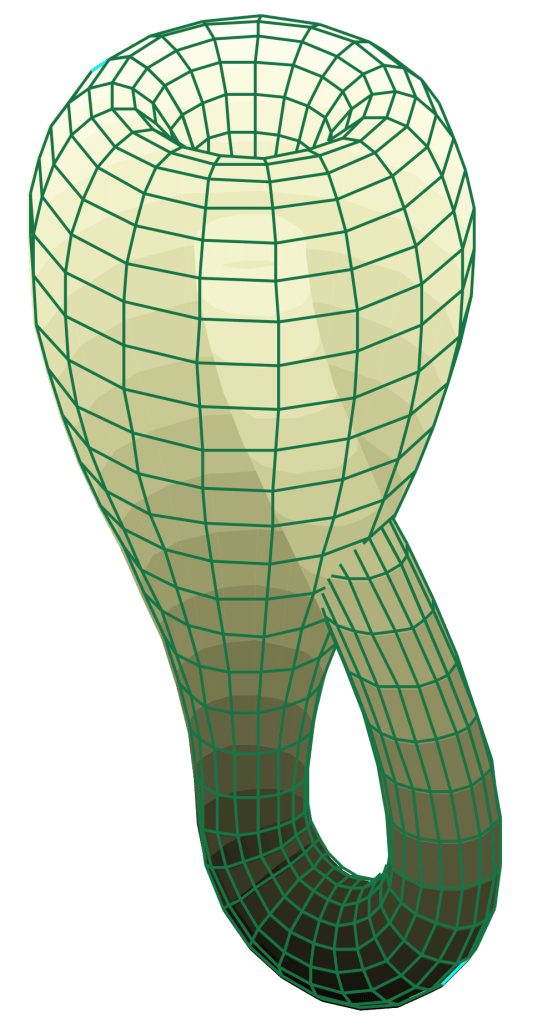
Enough theory, you are probably asking yourself: who comes up with the idea to make Klein bottles out of glass? Well, that would be Cliff Stoll. Cliff lives in California and runs the company Acme Klein Bottles™ (www.kleinbottle.com), where you can actually buy one if you like. He stores them in the crawl space under his house, and has built a DIY warehouse robot to maneuver the bottles in and out. I can heartily recommend his very enthusiastic Klein bottle explanations on Numberphile, YouTube!
As far as I know, Cliff Stoll is the only person who produces glass Klein bottles, which is why I am so excited to have found one in St. Michel! When I bought it, the vendor wondered what would happen if you tried to put water in a Klein “bottle”. This is totally possible! The question you ask yourself as soon as you actually own one, however, is “how on earth do I get all this water out of my Klein bottle?!”


Leave a Reply