

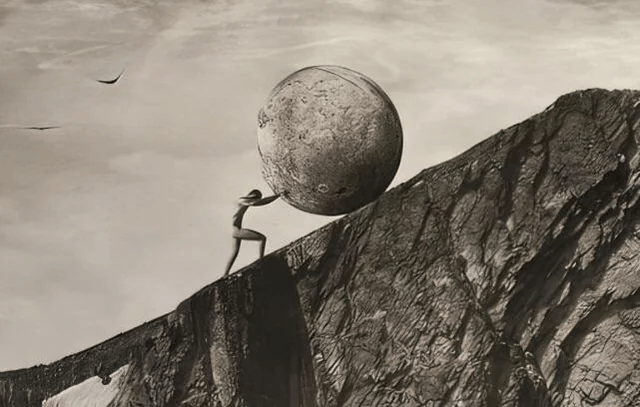
Sisyphus by Jeffrey Hummel
Orion Peyrol
Editor in Chief
October— while being a time of laughter, candy and silly costumes— can also be a time that makes us reflect on our fears. A fear is never just a fear, it’s always rooted in something deeper. The older I grow, the less afraid I am of the things that go bump in the night. The supernatural creatures of the world don’t keep me up anymore, the world we live in does.
I recently asked my mother if it has always felt like things were changing this quickly. Everyday I wake up and I feel like something else has been ripped from under our feet. Nothing feels assured anymore. I have been feeling…
Existential.
I can only describe it as having a crisis of faith—my devotion to the future is being tested. I think a lot of people have been feeling this way. There’s a blanket of uncertainty thrown over the next few years— mainly because of AI. There is no denying that AI is the biggest shift within the 21st century. It has metaphorically (and physically, thank you AI assisted bombing drones) blown up life as we know it. Now, this isn’t the first time humanity has had a shift this big, and it’s definitely not the first time we’ve had to grapple with a loss of meaning.
After World War II and its atrocities, people, understandably so, found it hard to return to daily life. Fears that people had long held had come true in unimaginable ways— industrial warfare, the atomic bombings, and the unimaginable horrors of the Holocaust left people feeling nihilistic like never before. You can’t unmake the atomic bomb and you can’t undo a technological revolution that’s already well underway.
Out of that desolation and fear, existentialism was born. The existentialist philosophers (Jean-Paul Sartre, Soren Kierkegaard, Albert Camus, and Simone de Beauvoir, to name a few) tried to make a philosophy to give life its meaning back, one you could actually apply to your everyday life. When I first came across existentialism, thank you Jessica Lim, I felt as though somebody was speaking directly to me across the sea of time. Thoughts and feelings I had had for years but never been able to aptly explain, had been put into words by people long dead. They had four main tenets to their philosophy, a philosophy that has served us well for decades at this point— but I also couldn’t help but feel that these tenets are under threat. That at least my way of seeing life, which tends to align with existentialism, simply could not coexist with AI.
There’s a new Halloween monster in town and this one doesn’t get packed back up in a cardboard box at the end of the season.
Tenet 1: Existence before essence.
This first point refers to the existentialist belief that humans are not born with an innate purpose. Rather, they believe that your purpose and meaning is shaped by you, and the choices you make throughout life. For them, there isn’t something or someone out there that has decided your fate before your birth. I love thinking this way, I feel it gives our choices so much more power— every choice we make is an act of building who you are and why you’ve decided to be here.
It’s traditionally a philosophy that denounces the existence of a God, at least of a God that decides who you are before you’ve even been born. As Nietzsche said, “God is Dead” but AI is trying to revive Him at the altar of the chatbox.
AI does have a purpose to it, it is literally given one before it’s even programmed. They have a voice in the clouds (or The Cloud) telling it who to be and how to do it; its God is the programmers that give it existence. An artificial intelligence doesn’t have to grow up and grapple with its existence like the rest of us. It comes out already grown and ready to work for the capitalistic overlords of the world. That makes us, or at least me feel… inadequate. If AI’s become the majority in the workplace we will no longer have the luxury of being unsure of where we want to go in life, or of learning along the way and changing our minds. Why would the big boss want someone fickle with wants and needs when they could have a robot whose entire purpose has been designed by him, or by people with his interests in mind, to do his exact bidding?
Tenet 2: Death is what gives our choices and life meaning.
There is no human nature in existentialism. Humans are not inherently good or bad; they can always choose to be something else as long as they’re alive. This is why death is the thing that makes our choices have meaning, because it’s what prevents us from infinitely changing. Eventually you will no longer exist, and only at that moment can you look at the choices you’ve made and define yourself as a person.
AI cannot die. It is not human; it will not perish unless we shut it off or stop maintaining it. Humans as a species don’t love things that can’t die or that come back from death. It’s a theme you can see throughout the monsters we’ve made: zombies, vampires, ghosts, Frankenstein’s monster, etc. We fear things that cannot die or are undead because that’s what definitively makes them not human. We’ve made something that could theoretically outlive us and outlive humanity as a species. That is an existential threat to our way of life; humans must die eventually but we really don’t want to. We chase legacy, fame and power as our philosophical stone to keep part of us alive even after we are gone. AI is just that, neverending, and we can’t help but find it uncanny that AI could hypothetically go on… forever.
Tenet 3: Ethical responsibility is first philosophy
Every philosophical theory, or most, have a point they view as their “first philosophy”, what you must initially consider when making a choice. For existentialism, it’s the idea of taking responsibility for your actions. It’s a philosophy that acknowledges that often the premise of situations are not in our control, you do not often have a choice in what happens to you. However, existentialism says that within those premises you are still responsible for the choices you make. You’re also accountable for making the choice you genuinely think is the right one, for yourself and humanity as a whole. Existentialism doesn’t really peddle a certain set of ethical guidelines, it’s a subjectivist philosophy that believes you must determine your own ethics. The only morally wrong choice is to avoid making choices as to avoid the responsibility and consequences of making a choice.
Artificial Intelligence is undermining this in two ways. Firstly, the choice to interact with it is no longer a choice, it’s completely unavoidable. The premise has been set without our input or control. Secondly, AI operates as an active removal of human choice, it consolidates our options into a singular AI overview or one program. Those AI’s have been trained on previously made human choices and puts them together in new ways but can never make something new only regurgitate what it’s been given. By making something through AI your choices are filtered through what the AI knows, nothing new is allowed to exist through this filter.
We’re outsourcing our agency to a thing that has no morality or ethical reasoning.
Our choices are barely our own anymore, the premise is encroaching on our ability to act within it and our ability to make meaning.
Tenet 4: The only two modes of life are Authenticity and Inauthenticity
Inauthenticity in existentialism refers to the expected mode of life, the daily humdrums: school, work, metro, eat, sleep, repeat. We do them without really thinking, we just keep going forward. Authenticity is the opposite, it’s these lapses of time where we see ourselves outside of quotidien life, as specs in the grand scheme of nature. When the fundamental lack of meaning present in what we’re doing presses down on us. Now, existentialism says that while our moments of Authenticity are important to us and have their own use, as humans, we will always return to a state of inauthenticity because it’s how we survive. As a species we wouldn’t be able to keep going if we were constantly doing mushrooms, staring at the moon and crying at her beauty and how nothing really matters.
AI is actively putting our inauthenticity into peril. The stability of the jobs and daily lives we rely on to survive and keep going have now gone wobbly. There’s a very real fear that our jobs will replace us and we will no longer have a reality to rely on. If we do not have our Inauthenticity to fall back to all we have left is Authenticity. Which is not a state that we can maintain, it always leads to despair. We need a structure to feel safe, to feel grounded within reality. Our fears around AI always lead back to the rapidly changing world and the way it’s shaking the foundations of society.
I’m a very optimistic person by nature, I fundamentally believe that eventually things will be okay. But AI makes me feel dumb for feeling that way. It’s hard to believe the way I want to believe in my own future and the future of my generation. We don’t know what world AI is making for us. But what I do know is that in the aftermath of it we will need a new way to see the world. A philosophy for the new generation.
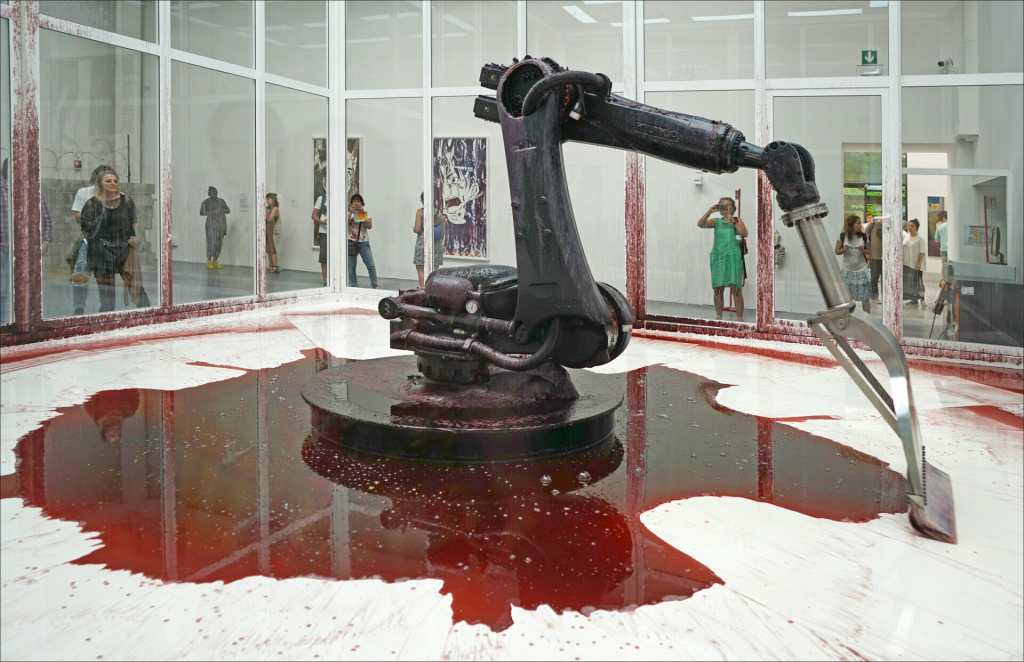
Can’t Help Myself By Sun Yuang and Pen Yu


Leave a Reply