

Via Cult MTL
Leo Baron
Staff Writer
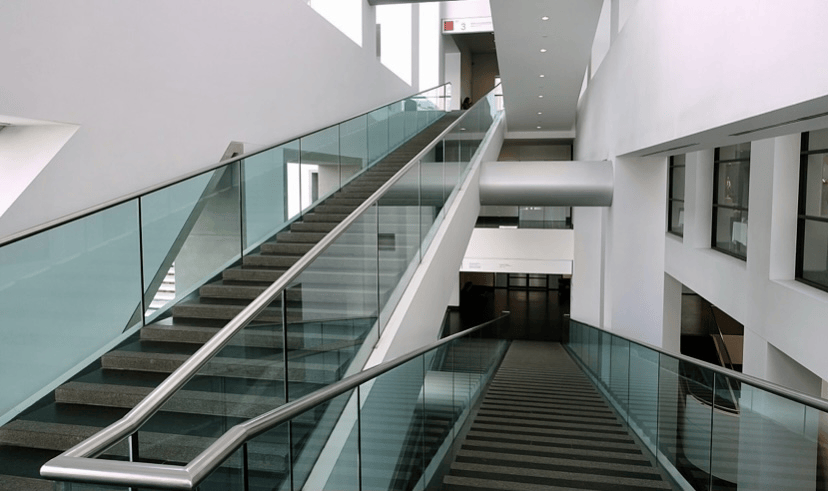
Here’s the tip of the iceberg. If you have ever been to the Montreal Museum of Fine Arts on Sherbrooke Street, you will have noticed that the flight of stairs to the right of the lobby, designed by the giant of architecture Moshe Safdie, are unusually treacherous. The steps are inordinately wide, with heights less than a fifth of what they should be. The unsatisfying walk up the stairs is precisely awkward because it asks the user to step outside of a habit. One who has walked up these stairs will understand the singular experience that I am referring to.
But more symbolically, these stairs purposefully alter the perception of movement for the user to slow down from their fast-paced life. It is not the same experience you get on a ten-second high racing down the metro stairs to catch a shutting door and a fleeting sense of satisfaction. Rather, this experience feels calmer — like it should be a meditation, but it isn’t. In fact, you can’t survive these stairs without being constantly interrupted by self-consciousness.
Safdie’s stairs are either a playground for children to run and screech loud echoes of beautiful nonsense that are hushed by the lungs of other frequent museum-goers or… what? What is the appropriate reaction to this physical phenomenon that disrupts casual transition? The most natural paradigm of thought gradually drifts from thinking about mundane absurdities like the unusual text you received in the morning, to “Who the hell designed these stairs?”, to “Where do I put my next foot?”, over and over again. Until finally, practically without noticing, you’ve entered a room full of Matisses that has been quietly conquered by posturing critics and big-time wanderers. This all points to a particular aspect of architectural design: it is not neutral. It directs how we think by subtly engaging our emotions. The stairs of an Apple store have empty gaps in between them, allowing customers to peek through at everything in the store. The stairs of a triplex apartment are spiralled, brittle and shaky, demanding more urgency. But in most cases, stairs are just stairs. They might be blue or Victorian with motifs, but really, most have no symbolic depth to them. The average staircase is boring and doesn’t ask the user to feel anything because… why should it? It’s just a staircase. Safdie does not want us to conform to the rhythm of infrastructure. Perhaps Safdie wants us to unlearn how steps should feel in order to learn how to pay attention. Perhaps Safdie wants art viewed exactly the way we view the stairs, that is, to wander and to critique simultaneously, in a place that does not tell us how to feel.
It’s a funny thing. Online, the Safdie stairs have been seriously condemned for their hazardous nature. This is true. The stairs have the potential to make an inattentive person fall. Does a piece of art need to ask for the user’s consent beforehand? According to the Régie du batiment du Quebec (RBQ), implemented a decade after the stairs’ installment, by law, Safdie’s creation shouldn’t exist. But there’s an ethical layer that protects Safdie. Is the idea of consent and the user’s complaint even justified in the first place if there is an elevator right beside the stairs? In essence, Safdie is asking the user to slow down, but when the user decides to take one step that is arguably worth five Safdie steps, they trip, then go to Reddit or Facebook and bring out their pitchforks. It is an impossible task to not laugh at the absurdity of this situation. Some say they are the worst set of stairs in North America, and some applaud their very existence. This whole situation compares itself to controversies surrounding the lack of censorship of horrific images online. Knowing that these images can sometimes appear, the user voluntarily continues to scroll nevertheless, even though there is an option to not open the app.
However, more pervertedly, is the intent of Safdie’s stairs to ruin a user’s ability to walk?
Safdie uses his stairs as a very meta device to critique the history and making of art as a spectrum of all kinds. This piece that comes close to harming someone challenges the purity of an artistic concept. Perhaps the definition of art has changed over time to excuse improper behaviour or to be the realm of invincible ethics. It is important to note that the wholeness or the acceptance of a trend, especially one that appears aesthetic and popular, doesn’t objectively make it ethical. Titles distract from people’s inexcusable actions. Perhaps artist is the only title that forgives Degas from being a misogynist or an antisemite. The point is, Safdie is not Degas. Safdie wants us to feel how equivalent not questioning art is to not questioning stairs that feel normal.
Safdie’s stairs criticize how little we appreciate the mundane. How little time we take out of our days to consciously reflect on things as banal as our own steps. If the meaning behind this piece of art could be extracted and visualized, it would look like a mirror. Can we ever escape our own image? Safdie’s intentional answer is “No,” but when you enter the exhibit, it changes to “Yes.” In a weird way, the discomfort of the initial contact with the first step before and after the exhibit signals a segmentation of the museum experience into two parts — the first part being the stairs and the ego, and the second being the admiration of paintings and the egoless. Perhaps the egoless is only known through analyzing and remembering where the ego was left. That itself is an egoistic quality.
Here is one final truth. Imagine repeating the name of a person fifty or so times. Eventually, the familiarness of that word causes it to utterly lose its meaning. The loss of symbolism is horrific. The words become unfiltered and raw sound vibrations that make you rethink what is coming out of your mouth. Similarly to Safdie’s stairs, the muscle memory of leg movement wears out, and the symbolism of a leg — the tool of navigation — is lost. Walking, like a word you repeated too much and are trying to reformulate into meaning, feels forced. You are confronted with something that destroys the symbolism of walking, and at a certain point, you forget how to walk, what to do, and why you are doing it. That feeling is a flicker of Jacques Lacan’s psychoanalytic theory of the Real, which is the remnant of what is repealed from the habitual, an area of experience language can’t name.
Through the glamourized trend of the anti-intellectual comment on social media, you can destroy the whole sincerity of a thought just by saying, it’s just blank followed by bro. An example of that would be to say, “They’re just stairs bro.” So let’s not get ahead of ourselves. They are technically illegal and slightly dangerous, but they aren’t twenty-foot ocean waves. They’re just weird, inappropriately sized stones that represent the function of how space orients and disorients you all the time, without you even knowing or questioning. And Safdie’s exaggeration of that idea, through his intentional design, drops you dead on your feet. Literally. No more gatekeeping — go try them out.


Leave a Reply