

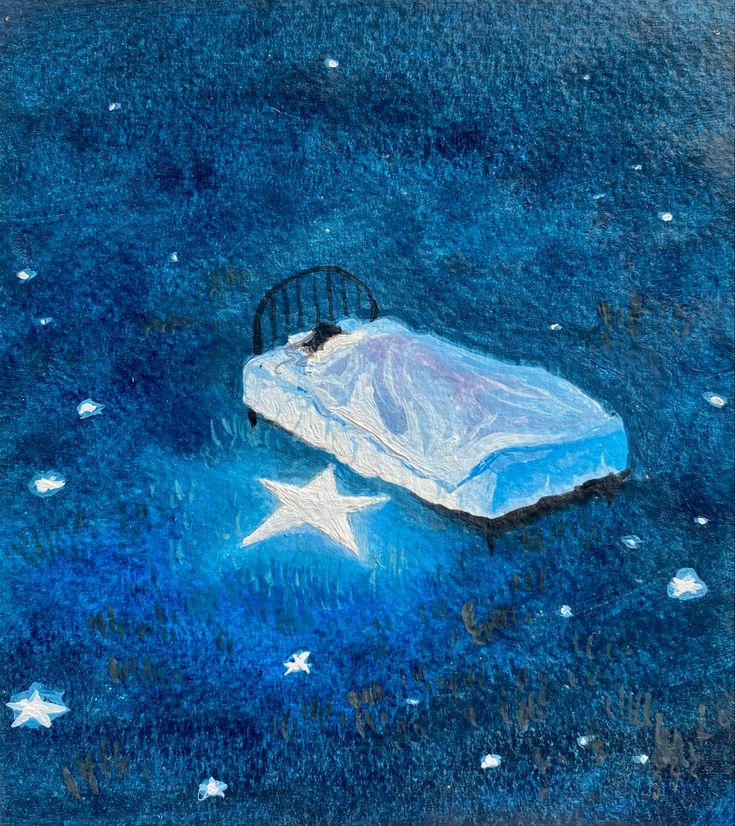
Via Pinterest
Lara Judah
Staff Writer
It is difficult to define what a dream is– it seems to lay on the precipice between the physical and the intangible; elusive in its explanation, but vivid in its imagery. From playing a central role in mind-bending movies such as Inception, to being used as a powerful device in historical speeches, dreams are all around us. They are also within us; some dissolve by morning, as our foggy brains clear up and forget about the images that had so troubled us during sleep. Others come back, again and again, repeatedly infusing us with a particular combination of emotions that are unique to that specific dream.
In a sense, dreams can serve as a gateway to a whole array of new feelings and experiences– they allow us to explore parts of ourselves that might otherwise be inaccessible.
Considering the impact of our dreams on our psyche, it is surprising that this topic remains one of the biggest mysteries within the field of neuroscience. Over the years, numerous attempts have been made to provide an answer to the question of why we dream.
In 1899, Sigmund Freud took a fascinating approach, as described within the pages of his magnum opus, The Interpretations of Dreams. He suggested that dreams reveal our hidden desires. Freud’s hypothesis, formed before the discovery of REM sleep, stated that dreams “released” our repressed wishes, often disguising them as symbols. According to Freud, this would allow us to subconsciously fulfill our desires without having to directly— and uncomfortably— deal with them during our waking hours, when we are operating under the moral and ethical constraints of society. Though this psychoanalytic theory was later criticized for its lack of scientific evidence and reductionistic qualities, Freud established the idea that emotions do connect with our dreams in a fundamental way, even if their function is not yet clearly defined.
However, emotions do not play a role in all hypotheses concerning the “why” behind dreams. Perhaps one of the most widely accepted theories in oneirology (the scientific study of dreams) is the activation-synthesis model, which provides a rather disappointing answer: dreams are completely random. In the late seventies, two psychiatrists, J. Allan Hobson and Robert McCarley, proposed that during REM sleep, the brain seeks to synthesize all the random electrical impulses that are created in the brainstem. Essentially, that dream in which you fail the calculus final that you’re so worried about? Purely coincidental, apparently.
And yet, we cannot deny that our dreams must surpass mere coincidence. Though Freud’s theory has been met with skepticism, Hobson and McCarley failed to explain why we often dream so coherently and intensely. Having visions of various integrals and derivatives the night before your math exam or dreaming about awkward interactions with acquaintances are not merely products of randomness. They are related to our fears and aspirations in some form, though the exact connection has yet to be identified. Alternative theories are continuously being pursued, such as the Threat Simulation Theory, where dreams serve as a biological defense mechanism, and the novel Overfitted Brain hypothesis, which integrates Deep Learning and artificial neural network concepts.
Perhaps these advances will someday allow us to decode this foreign language that we dream in. But maybe this lack of information is a gift; it is precisely the mystery of dreams that allows our minds to pleasantly meander through all the possibilities regarding their significance. They can be a source of comfort, a means of escape. To embrace the strange and wonderful world of dreams— devoid of the anxieties that so often impede our daily lives— is freeing.


Leave a Reply