

Via Getty Images
Atika Ume Fazal
News Editor
Preface: Israel’s murder of countless government officials, journalists, academics, and international humanitarian workers has significantly reduced the amount and the frequency of statistics and studies coming out of Gaza. This article tried to stick to the most certifiable data, which often dates back to 2025 UN studies. Considering the genocide on Palestinians has not stopped since, it is far probable that these numbers show a conservative estimate of the consequences inflicted by Israel on this territory.
For students around the world, the months of September and October mean an abrupt and taken-for-granted return to classrooms.
In North Gaza, every classroom has been reduced to rubble by Israel.
Across the Gaza Strip, 91.8% of all school buildings need to be either fully rebuilt or undergo major renovations to be functional according to an OCHA 2025 study. The few remaining school buildings are mostly being used as shelters for the displaced Palestinian families.
Nevertheless, after three years of ongoing genocide, provisional solutions have been found.
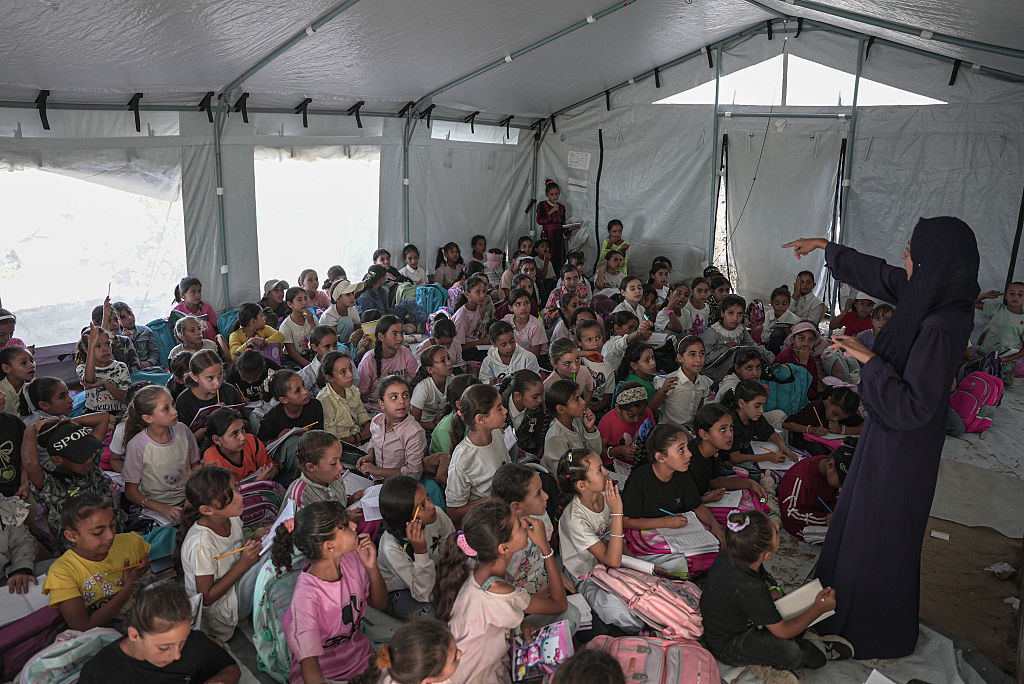
One of these solutions is Temporary Learning Spaces (TLS). Often situated in tents, TLSs have allowed almost 500 000 students aged from 4 to 17 to obtain some form of education. This is only 59.2% of the affected population, with the rest still being outside of learning abilities, as reported by WeWorld.
Conditions in temporary learning spaces remain inadequate. Palestinian eighth grader Yamen Abu Samra relays the condition to Reuters: “There are no fans, no light bulbs, no electricity, no generators, no power panels. Now, I am sitting in a tent that has absolutely nothing, nothing but the sun and heat. […] And the area isn’t tiled, it is just sand. I am sitting on sand.”
The fourteen year-old also adds the general feeling of anxiety that plagues the Strip:
“When we come to school, we’re afraid of stray bullets, rockets, strikes, everything.”
Considering the death count of over 75 000 civilians, this fear is in no way unfounded. OHCHR claims that over 20 000 children have been murdered in Gaza from October 2023 to October 2025 in a “widespread and systematic” targeting of youth by the occupation. Those numbers represented 30% of the killed population up until then, and the genocide continues on today.
Students and children are not the only ones affected: Israel had murdered over 780 teachers as of October 1, 2025. However, the number of injuries for that time period, according to OCHA, was much higher. In fact, they report that more than 3,000 teachers were severely injured.
In the temporary learning spaces, these attacks on teaching staff translates to overcrowded classrooms and a barely manageable teacher-to-student ratio today. According to WeWorld, more than 500,000 students seeking education must be taught by about 11,000 teachers — which would represent a ratio of about 45 students for every one teacher.
The New Arab recounts the experience of Deena Allouh, an English teacher in Gaza. After leaving her partly-destroyed home, she must walk an hour to go teach 250 students. In the classroom, she must face traumatized children, all of whom have experienced personal and educational loss.
“Many students have grown up during the war and are not familiar with the educational process and do not understand what school, a teacher or a lesson means,” she explains.
Deena also talks about how the trauma of years of genocide have affected her students: “Most of my students lost some of their siblings, parents, relatives or classmates. I recognize the effects of their trauma in their social withdrawal, anxiety, difficulty concentrating, and changes in behaviour and academic performance.” Teachers in Gaza also face these losses, and must juggle their own traumas along with those of their students.
Gordon Brown, the UN Special Envoy for Global Education, tells a General Assembly on September 24,2026 that “education is so important for the future of the Palestinian people”. Yet, Israel continues to destroy the very foundation of it: buildings, students, teachers, hopes.
“Despite all of this we will learn, we will learn even in a tent,”
a student in Khan Younis states.


Leave a Reply