

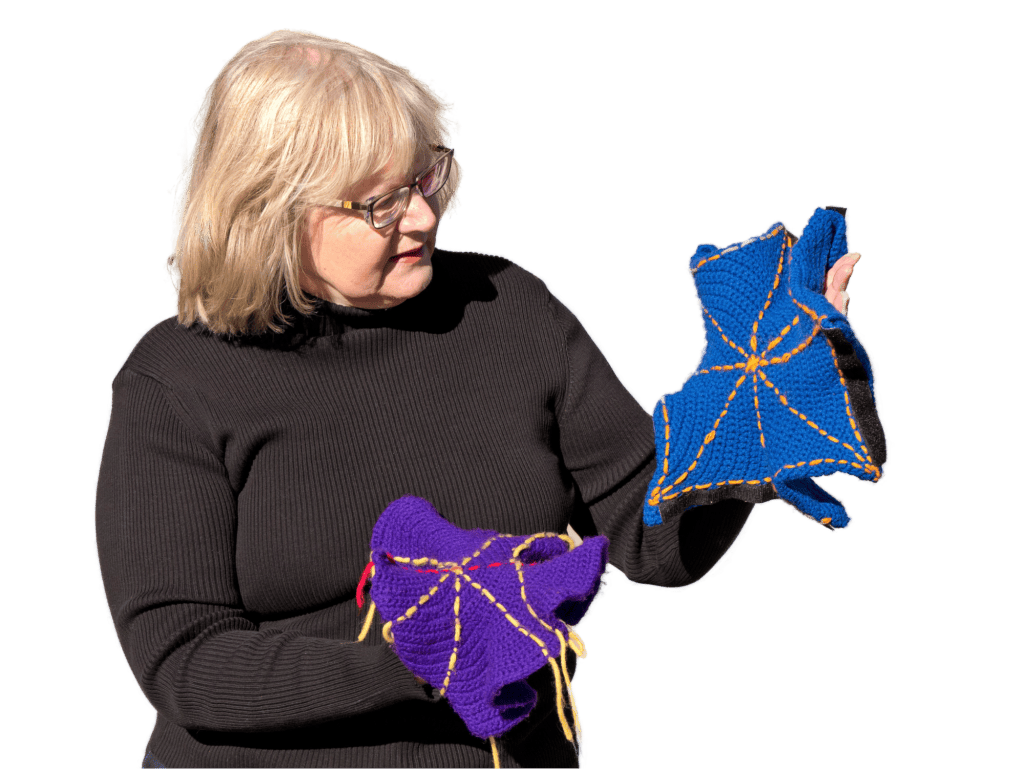
Via Daina Taimiņa
Charlie Reuter
Science & Environment Editor
Do you remember your high school teacher telling you that the angles in a triangle always sum to 180°? (When I asked this at the Plant office, almost all hands went up.) Well, your teacher didn’t tell the truth. Those angles can sum up to pretty much anything you like. To see why, grab some yarn and a slightly surprising but revolutionary mathematical tool: the crochet hook.
This story begins in Ancient Greece, with a textbook: Euclid’s Elements. Spanning 13 volumes, it’s an impressive attempt to rigorously prove the field of mathematics as it was known at the time, with only the ruler and the compass for tools. In order to prove mathematical theorems, Euclid had to start somewhere. He settled on five obviously true statements, or “axioms,” from which he was able to derive all other theorems. One axiom, for example, is “all right angles are equal.” An immense success, the Elements remained the leading mathematical textbook up until the early 19th century.
Then, some 2000 years later, we realized that the “obviously true” axioms aren’t actually true at all.
Another axiom states that, if one has an arbitrary straight line and an arbitrary point, it is possible to draw exactly one line which goes through the point and is parallel to the (first) line. This sounds quite obvious, if one imagines drawing it on a flat piece of paper. But what if the surface we draw on isn’t flat at all — what if it’s curved? Welcome to: non-Euclidian geometry.
There are two types of curvature. The first one is simpler, so let’s start there: picture a sphere. On this surface, there are no parallel lines. (We define two lines as being parallel if they never intersect, even if we extend them infinitely.) On a sphere, any two straight lines seemingly “curve” together and eventually intersect. Think longitude lines on a globe, which intersect at the North & South Poles. Latitude lines aren’t actually straight lines – you need to turn if you’re walking along them.
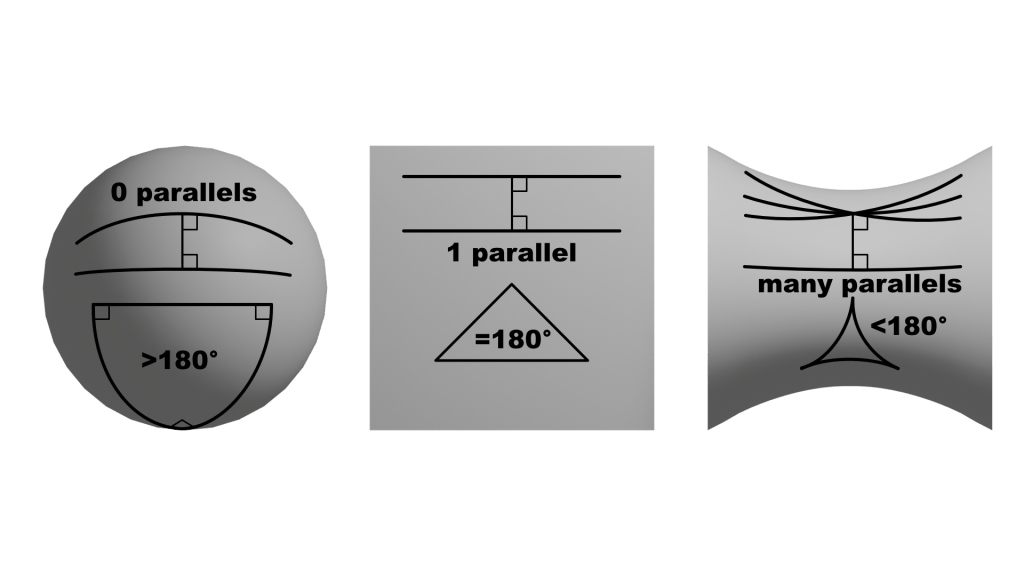
On a sphere, not only do Euclid’s assumptions on parallel lines not apply, even the “impossible” triangle with three right (90°) angles becomes possible! See the diagram, on the left: despite the triangle seeming “bulgy,” on this spherical geometry, each of its lines is in fact perfectly straight, being the shortest path between two points.
The other type of curvature, called hyperbolic, is less intuitive. On a hyperbolic surface, there are an infinitude of parallel lines all going through one single point! For centuries, this surface was considered near impossible to visualize, and the very few models that existed were flimsy paper constructs, too fragile to handle.
That is, until 1997, when mathematician Daina Taimiņa realized that the abstract surface she was trying to explain to her students was what she had been crocheting all along. She was the first to introduce a tactile, visual model.
In crochet, one can “increase” stitches by going through the same stitch of the previous row twice. When stitches are increased, the fabric starts to curl, a technique used to shape a hat, for example. If one increases too often, though, the fabric curls so much, it creates a coral-like structure.
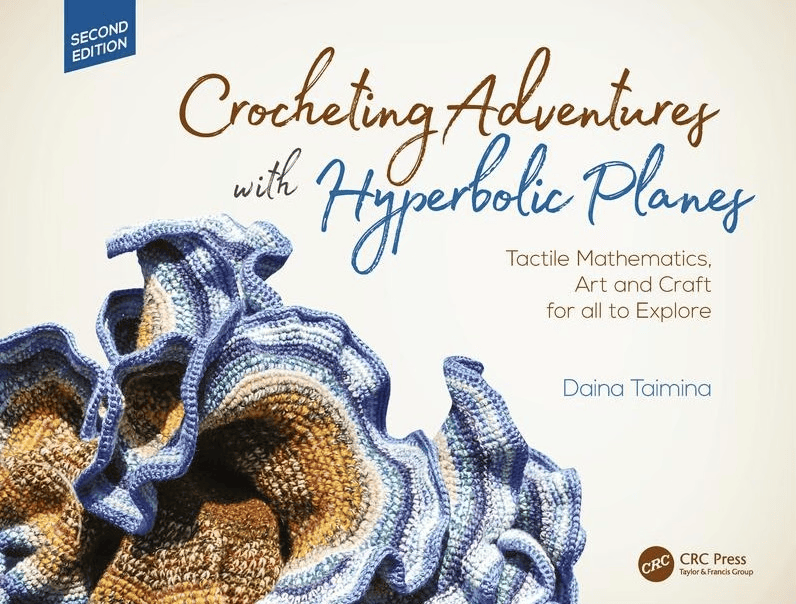
This curly shape is actually a hyperbolic surface! If you were to draw two parallel (straight) lines on your crocheted piece, it would seem as though the lines were curving away from each other; in reality, it is the surface which expands between them. This curvature makes it possible to draw multiple parallel lines through the same point. On a hyperbolic surface, one can also create a triangle with three 0° angles (see the diagram, on the right)!
The reason the increased-stitch crochet work looks like a coral is because corals actually are a naturally occurring hyperbolic surface growth! In fact, a lot of shapes in nature (take kale, for example) tend to be hyperbolic, in order to increase the amount of surface area without taking up too much space. This is useful to capture more sunlight, to gather more nutrients, etc. Physicists even consider our entire universe to have a hyperbolic shape.
But let’s get back to your crochet hook. Crocheting a hyperbolic surface is very easy: if you know how to crochet back and forth on a chain, you’re all set. Start with a chain of about 10 stitches. Now, crochet back and forth, but every 4th (or 5th) stitch, instead of moving to the next, go through the same hole twice to increase. Look at you, breaking those millennia-old geometry rules! Your grandma would be proud.
If you want to find out more, you should definitely check out Prof. Taimiņa’s excellent TED talk, or her books Experiencing Geometry (which is open source and can be found online) and Crocheting Adventures with Hyperbolic Planes. The latter won the Euler Book Prize — and yes, also the “Oddest Title of the Year” award!


Leave a Reply