
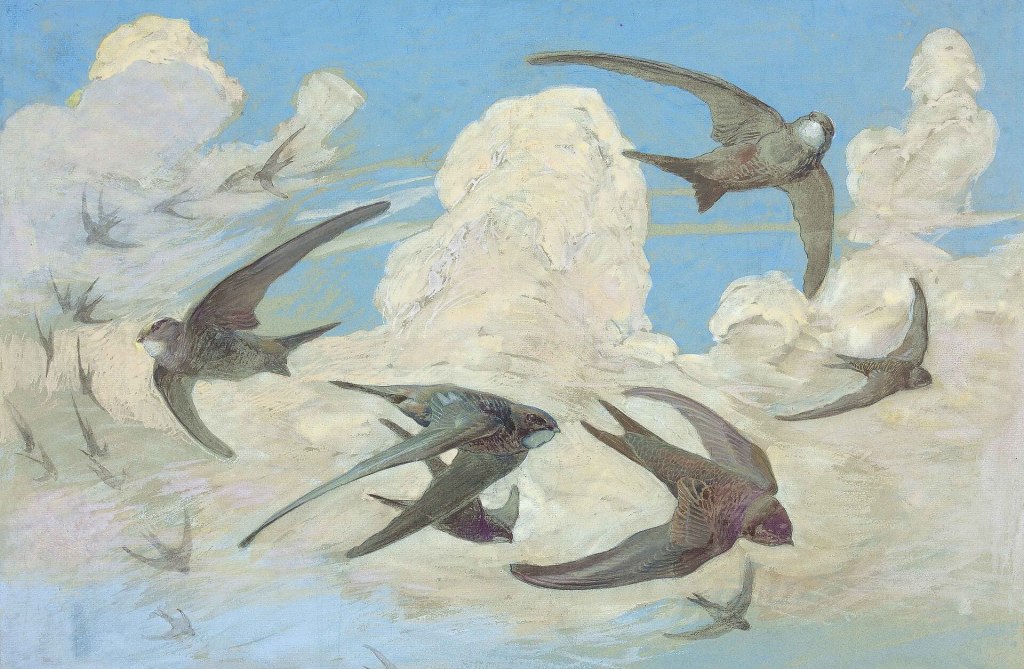
Mauersegler By Léo-Paul Samuel Robert
Chloe Bercovitz
Co-Editor in Chief
Among the bleaker moments, in which I feel less than myself, I cannot help but resort to nature. Because, to me, to be outside is to be free. I am unconfined. I feel small — as big, beautiful things nestle around me: trees, rain, birds, even. And, I think of Mary Oliver. She whispers to me:
“You do not have to be good. You do not have to walk on your knees for a hundred miles through the desert, repenting. You only have to let the soft animal of your body love what it loves.” This mantra of mine is echoed from her 1986 poem Wild Geese.
It becomes easier to accept oneself, only upon stepping outside of the world we have created for ourselves. Our very best tool for perspective is natural: it is nature. And what a comfort it is to know that time and time again, the human race will forever have the same refuge!
And yet, the other world of urbanity that we find ourselves returning to, rarely affords us the same freedom that I speak of. We live in a culture that has found itself concerned more with the future than with the present tense.
I think of all the ways in which we attempt to ameliorate our mental health. What are we told? To track our habits, optimize our routines, wake up earlier, scrutinize our shortcomings — in the name of self-improvement? This is not to say that I blame anything new; it is our nature. Take Aristotle’s conception of well-being, eudaimonia: the cultivation of virtue through the exercise of human capacities. Yet, there is a distinction between cultivating a life that is true to your character and desires — and treating oneself as defective. The former asks what kind of life is worth living. The latter asks what must be fixed before we can be satisfied with the one we have.
And all while acknowledging the merit of such things, I’d like to suggest an alternative, as well. I have such an issue with the weight and strain of our omnipresent, shared assumption that our present selves are perpetually insufficient.
How can we possibly let ourselves live and love if we think that something is wrong with us?
I invite you into a world in which the narrative is shifted. You will be embraced with open arms by Mary Oliver herself. Nature offers a way to reconsider my distinction!
Its rhythms do not conform to our expectations of constant progress. A tree loses its leaves without becoming less of a tree. A field lies dormant without forfeiting its capacity to bloom.
But as individuals, we want uncertainty to resolve into certainty — for rest to produce energy, and for every difficult period to yield some discernible lesson. We have always demanded that our suffering ought to justify itself through growth.
And while I’d like to think that I have more obligations than the maple tree that is forever perched on my front lawn — and I recognize that nature couldn’t find itself as a cure for the social conditions that have made such relentless productivity ever so necessary – nature will always be one of the most valuable reminders to us all, in its own right.
Not everything meaningful can be measured. Not everything that matters must be rendered useful, in some way.
So, in choosing not to be good, one does not need to reject the possibility of change. I would argue that the first stop lies in reflection, and changing our way of approaching it. Because, we can strive towards a better life without making our present one an obstacle to it. We can feel our struggles, deeply, without having them dreaded — embedded within our identity.
When I step outside, and I sip my coffee in my backyard, I know that I am not free of my insecurities, or my ambitions. They are still me. The world I have hoped to step away from will forever remain waiting for me. But it is in those moments that my attention belongs to something other than myself. The birds move through the sky without needing to justify to themselves the direction in which they have chosen.
And I am reminded, as well: I exist beyond the sum of my aspirations. And whenever I do not feel as if I am being good enough, Mary Oliver is there, kindly offering me a second reminder:
before I can become anything, I am already here. I am not a problem to be solved. I need no justification to be.


Leave a Reply